


The Countries Competing to Become Africa’s Biggest Tech Hub
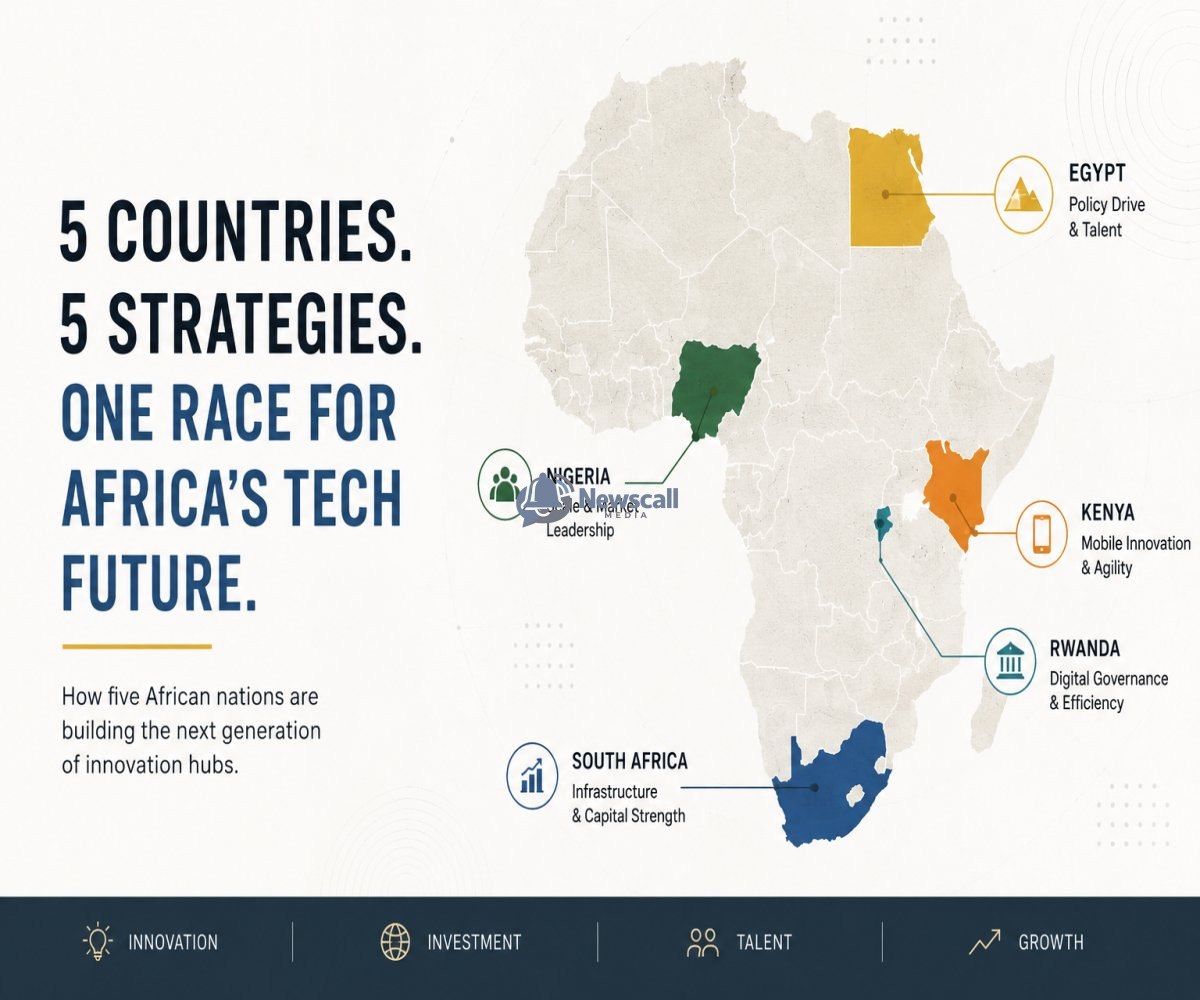
Across Africa, a clear pattern is emerging: instead of a single dominant technology center, multiple countries are competing to define the continent’s digital future. Each is building a distinct model of innovation shaped by policy, infrastructure, capital, and startup ecosystems.
The result is a highly competitive but fragmented landscape where Nigeria, Kenya, South Africa, Egypt, and Rwanda are leading different dimensions of Africa’s tech transformation.
Nigeria: Scale, Demand, and Startup Density
Nigeria remains Africa’s most influential technology market by sheer scale. Its large population and rapidly growing digital consumer base make it a natural launchpad for startups targeting mass adoption.
Lagos, in particular, has become the continent’s most active startup city, producing globally recognized fintech companies such as Flutterwave and Paystack. The ecosystem is characterized by high entrepreneurial activity and strong early-stage innovation.
However, Nigeria’s strengths are tempered by structural challenges. Currency volatility, infrastructure limitations, and regulatory uncertainty continue to affect investor confidence and long-term scalability.
Despite this, Nigeria retains a key advantage: unmatched market size and startup density, making it the continent’s most active engine for tech experimentation and consumer-driven innovation.
Kenya: The Mobile-First Innovation Leader
Kenya’s tech ecosystem is widely regarded as one of the most innovative in Africa, largely due to its early adoption of mobile-based financial systems.
Nairobi—often referred to as the “Silicon Savannah”—has built a strong reputation in fintech, agritech, and mobile payments. The country’s innovation model is rooted in practical solutions to everyday challenges, particularly in financial inclusion.
Kenya consistently ranks among Africa’s top startup ecosystems, supported by strong mobile penetration and a culture of digital financial services.
However, the ecosystem remains concentrated, with a limited number of large-scale startups driving much of the funding activity. Scaling beyond regional success remains a key challenge.
Kenya’s strength lies not in size, but in its ability to produce efficient, mobile-native innovation systems.
South Africa: Infrastructure and Capital Depth
South Africa remains one of the most structurally advanced tech ecosystems on the continent. With established financial systems, stronger infrastructure, and deeper venture capital presence, it provides a stable environment for startups and scale-ups.
Cities such as Cape Town and Johannesburg serve as major hubs for fintech, software development, and enterprise technology.
South Africa consistently ranks as Africa’s leading startup ecosystem in overall maturity due to its institutional strength and access to capital.
However, growth in early-stage startup formation is slower compared to East and West Africa, and socioeconomic inequality continues to limit broader digital inclusion.
South Africa’s role is best understood as the continent’s financial and infrastructural backbone for technology development.
Egypt: Rapid Expansion Through Policy and Talent
Egypt has emerged as one of the fastest-growing technology ecosystems in Africa. Its large pool of technical talent, combined with increasing government support for digital transformation, has accelerated startup growth across multiple sectors.
Fintech, logistics, and e-commerce are particularly strong areas of expansion. Egypt also benefits from its strategic geographic position, connecting Africa, the Middle East, and Europe.
While macroeconomic instability remains a concern, Egypt’s startup ecosystem continues to gain momentum, driven by policy direction and increasing foreign investment interest.
Egypt’s model is increasingly defined by structured acceleration rather than organic startup growth.
Rwanda: A Controlled Model of Digital Transformation
Rwanda represents a different approach altogether. Rather than competing on market size or funding volume, it is positioning itself as a model for efficient, government-led digital transformation.
Kigali has become a testbed for smart governance systems, digital infrastructure, and streamlined public services. The country’s leadership has prioritized technology as a central pillar of national development strategy.
While Rwanda’s startup ecosystem is relatively small due to its limited domestic market, its regulatory clarity and execution speed make it an attractive destination for pilot projects and foreign partnerships.
Rwanda’s competitive edge lies in its ability to implement digital systems quickly and consistently at a national level.
Conclusion: A Multi-Hub African Tech Economy
Africa’s tech landscape is not converging toward a single dominant hub. Instead, it is evolving into a network of specialized ecosystems, each with a distinct advantage:
Nigeria: market scale and startup density
Kenya: mobile-first innovation
South Africa: capital and infrastructure
Egypt: rapid policy-driven expansion
Rwanda: digital governance and execution efficiency
The competition among these countries is not zero-sum. In many ways, it is collectively strengthening Africa’s position in the global technology economy by diversifying innovation models across the continent.
The future of African tech will likely be defined not by a single “Silicon Valley equivalent,” but by interconnected hubs, each contributing uniquely to a broader continental ecosystem.

Victor Oluebubechukwu Akuma.
Creative writer