

Bitcoin Dips Below $80,000 as Iran Dismisses US Hormuz Deal, Calling It ‘Unrealistic’

Bitcoin’s sudden slip under the $80,000 mark on Thursday evening wasn’t just another blip on a trader’s screen it was a visceral reaction to fresh geopolitical tension and the sobering reality that not every rally ends in cheers.
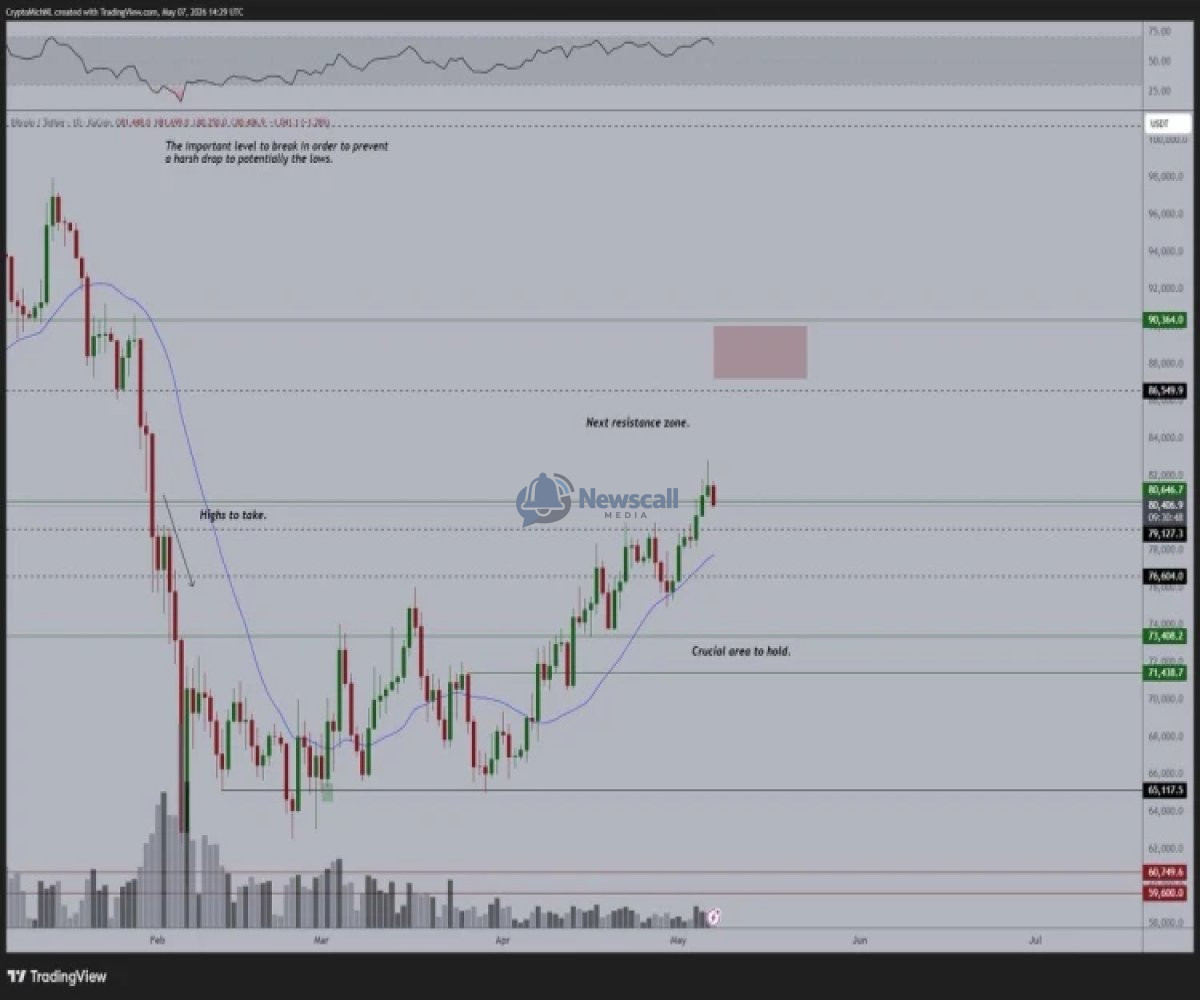
After a breathtaking 37% climb since early April, the digital currency stumbled, falling roughly 1.76% to trade just below $79,840. For a few hours, it looked like Bitcoin might hold above $81,000, but the optimism faded fast. The trigger? A blunt refusal from Tehran.
A Diplomatic Standoff Shakes Confidence
Just when reports of progress in U.S.-Iran talks had started to soothe jittery markets, an Iranian official named Mohsen Rezaei poured cold water on the proceedings. He declared that Tehran would not accept Washington’s latest proposal to reopen the strategic Strait of Hormuz—not unless the U.S. first agreed to pay reparations for wartime damages.
Calling the American framework “unrealistic,” Rezaei made it clear that Iran isn’t interested in what he called “symbolic concessions.” For anyone watching global markets, that’s a chilling signal. The Strait of Hormuz isn’t just another waterway; it’s the jugular of world energy shipping. Any disruption there ripples outward, inflating oil prices, stoking inflation fears, and making investors think twice before touching riskier assets like crypto.
Behind the scenes, negotiators had been sketching out a fragile ceasefire that included a 12-to-15-year freeze on Iranian uranium enrichment, partial sanctions relief, and a pathway to reopening the strait. But the two sides remain miles apart. Iran wants broader sanctions lifted, formal recognition of its control over strait traffic, and direct compensation. Washington, with Secretary of State Marco Rubio leading the charge, has flatly rejected any plan that would let Iran effectively tax international shipping.
Adding to the unease, former President Donald Trump chimed in with a warning: if no final deal emerges, the U.S. could resume bombing—this time at a higher intensity. That kind of talk doesn’t just move oil markets; it sends a chill through every corner of global finance, crypto included.
Traders Decide It’s Time to Cash Out
But geopolitics is only half the story. Even before Iran’s rejection landed, savvy Bitcoin traders were already reaching for the sell button.
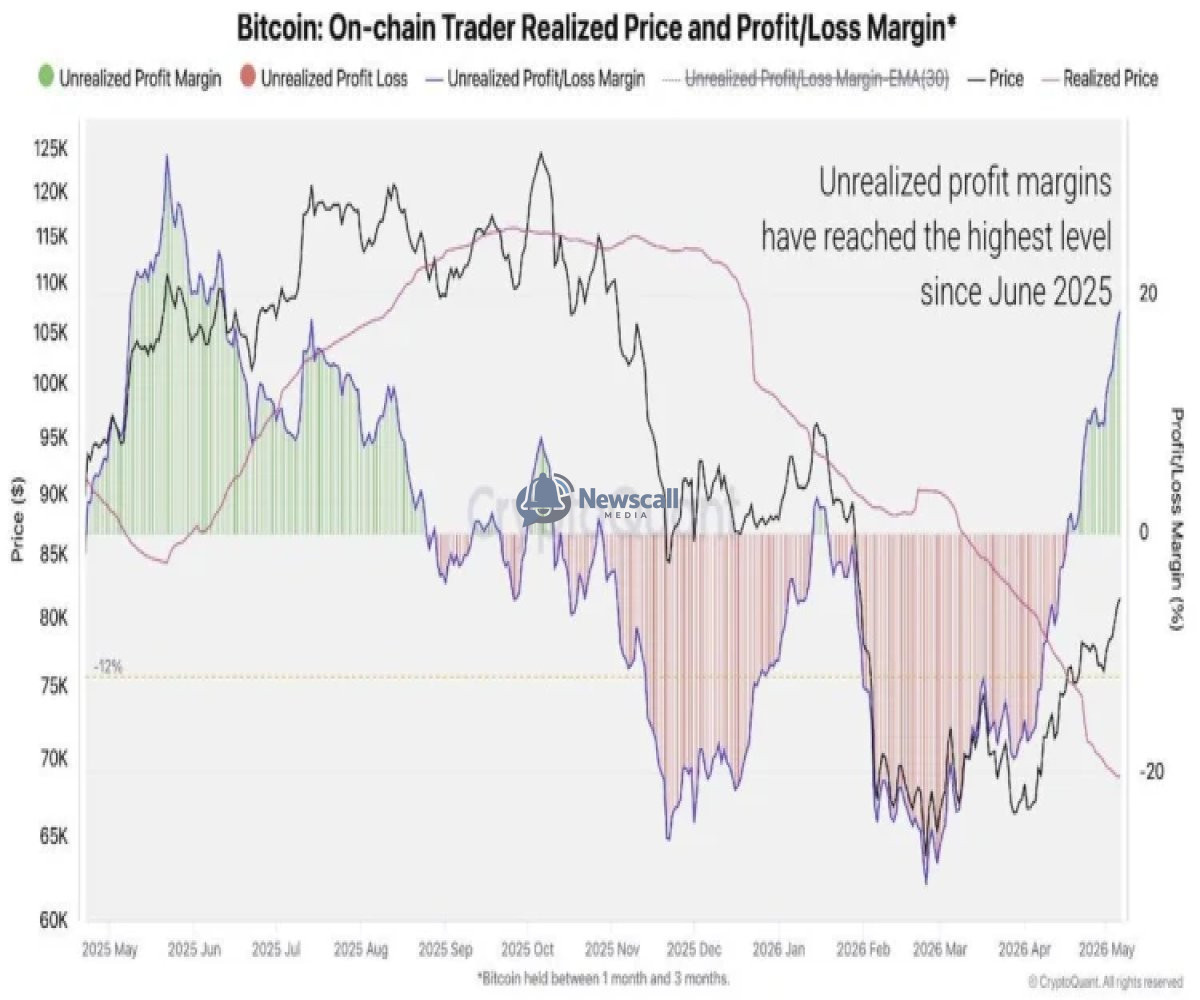
Blockchain data from CryptoQuant shows that on May 4, daily realized profits hit 14,600 BTC—the highest level since December 10, 2025. In plain English: a lot of people were suddenly very willing to take money off the table. The Short-Term Holder SOPR (a metric that tracks whether new investors are selling at a profit) edged up to 1.016, confirming that recent buyers were locking in gains.
For the first time since just before Christmas 2025, Bitcoin holders on a 30-day rolling basis are realizing net profits. That’s a striking reversal from February and March, when the market was bleeding red with net losses as deep as minus 398,000 BTC.
Meanwhile, the average trader’s unrealized profit margin climbed to about 18%—a level not seen since June 2025. Historically, when paper profits get that plump, the temptation to turn them into real money becomes almost irresistible.
That said, profit-taking doesn’t always spell disaster. Perpetual futures demand is still humming, spot buying hasn’t completely dried up, and exchange inflows remain relatively muted compared to previous crash scenarios. So while the air is hissing out of the balloon, it’s not popping—at least not yet.
What the Charts Are Whispering
Technically, Bitcoin finds itself at a crossroads. After sweeping through a pocket of short-side liquidity between $80,000 and $84,000, the market is now hovering near a major decision point.
Analyst Ali Martinez points out that the next big liquidity pools are sitting lower, around $75,000, $73,000, and even $70,000. At the same time, Bitcoin is brushing up against its 200-day exponential moving average—a long-term trend line currently near $82,162. That line has turned into stubborn resistance; every time BTC tries to climb above it, sellers step in.
Renowned analyst Michaël van de Poppe offered a calmer take. He reminded followers that markets rarely move in straight lines. “Assets often move in waves,” he said, suggesting that this pullback might just be a healthy consolidation after days of relentless upward momentum.
For now, the $79,000 to $80,000 zone is acting as the first line of defense. If that breaks, attention will quickly shift down to the $73,000–$74,000 area—a region many traders view as a critical “higher low” for the current recovery.
On the flip side, if Bitcoin can muster the strength to push past $86,500, the path could open toward $90,000–$92,000, where the next real supply wall is waiting.
For the moment, though, Bitcoin feels every bit the hostage of both geopolitics and greed—caught between Tehran’s hardline stance and its own holders’ itchy trigger fingers.

Umeanozie Prosper
Writer, Novelist,blogger, content creator