

How A Miscalculation Led To One Of History's Greatest Discoveries
History remembers great discoveries as moments of brilliance.
A scientist makes a breakthrough.
An explorer finds a new land.
An inventor creates a revolutionary machine.
The story usually sounds simple.
Someone was right.
The world changed.
But reality is often much stranger.
Sometimes history changes because someone was completely wrong.
One of the greatest examples occurred more than five centuries ago when a determined explorer set out to prove an idea that many experts believed was flawed.
His mistake would accidentally reshape the course of human civilization.
His name was Christopher Columbus.
And he misunderstood the size of the world.
Most people grow up hearing that Columbus proved the Earth was round.
It's a popular story.
It's also largely untrue.
Long before Columbus was born, educated scholars already knew the Earth was spherical.
Ancient Greek mathematicians had even estimated the Earth's circumference with impressive accuracy.
By the late 1400s, the debate wasn't about whether the Earth was round.
The debate was about how big it was.
This is where things became interesting.
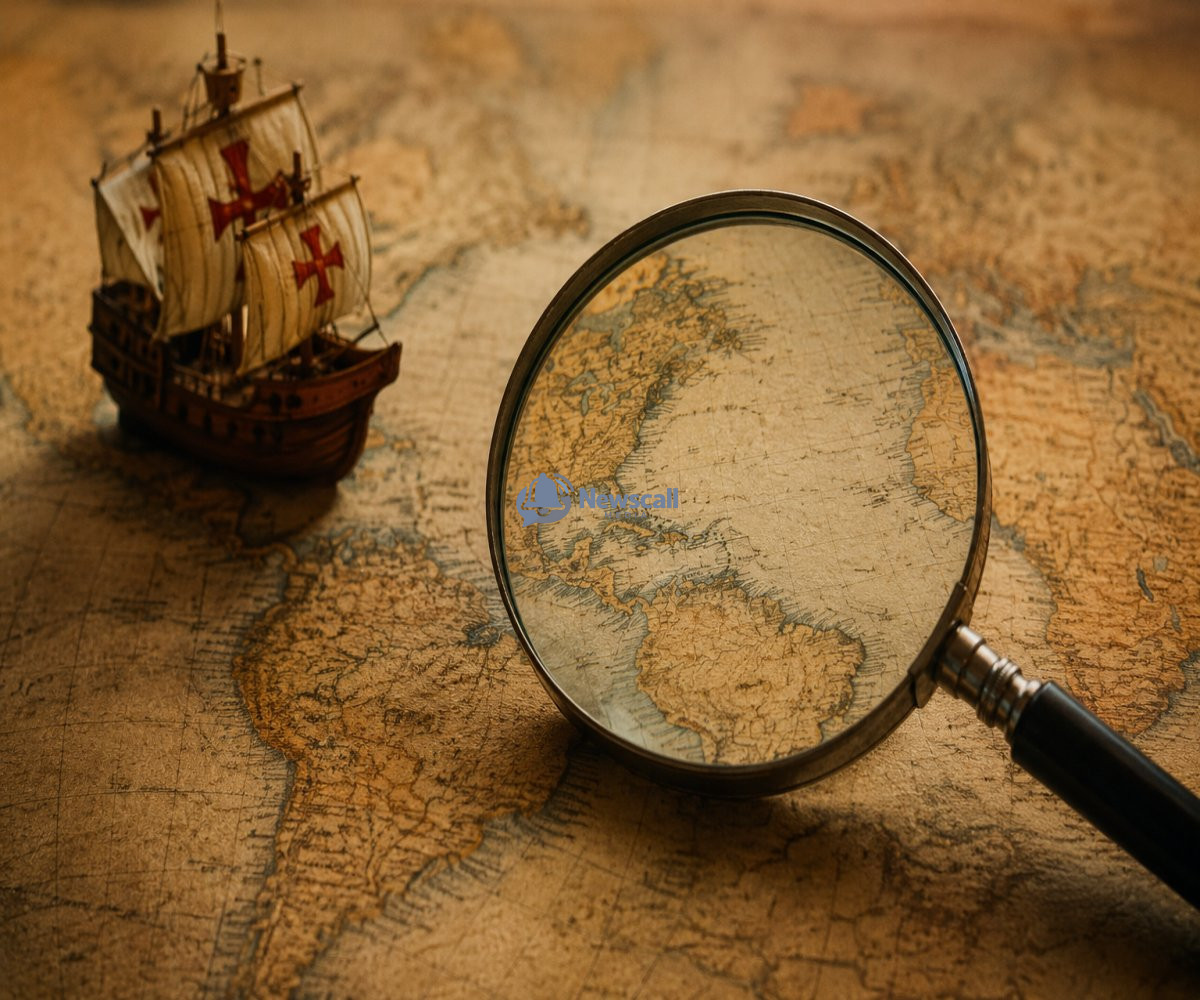
Columbus believed Asia could be reached by sailing west across the Atlantic Ocean.
At first glance, the idea seemed reasonable.
After all, if the Earth is round, eventually traveling west should bring you east.
The problem wasn't the direction.
The problem was the distance.
Most experts of the time calculated that the journey would be far too long.
Ships couldn't carry enough food and water.
Crew members would likely die before reaching their destination.
The voyage appeared impractical.
Columbus disagreed.
After studying maps, geographical texts, and various calculations, he became convinced that Asia was much closer than most scholars believed.
There was just one problem.
His calculations were wrong.
Very wrong.
Columbus underestimated the circumference of the Earth.
At the same time, he overestimated how far Asia extended eastward.
These two errors combined to create a dangerously inaccurate picture of the planet.
In his mind, the gap between Europe and Asia seemed manageable.
In reality, the distance was far greater.
Ironically, many of the experts who criticized his proposal were closer to the truth than he was.
Yet Columbus remained convinced.
He spent years trying to secure funding for his expedition.
Several rulers rejected the idea.
Others considered it too risky.
Eventually, the Spanish monarchy agreed to support the voyage.
And so, in 1492, three ships departed from Spain and headed west into waters few Europeans had crossed.
What happened next is one of history's greatest ironies.
Columbus was wrong.
But he wasn't wrong in the way anyone expected.
Had the American continents not existed, his expedition would likely have faced catastrophe.
The ships probably carried insufficient supplies to survive a direct voyage to Asia.
The experts' warnings would have been proven correct.
Instead, something extraordinary happened.
A vast landmass stood between Europe and Asia.
A landmass unknown to Europeans at the time.
When Columbus eventually reached islands in the Caribbean, he believed he had arrived near Asia.
Even after multiple voyages, he continued to think he had reached parts of the East Indies.
In fact, that's partly why Indigenous peoples in the Americas were historically referred to as "Indians."
The mistake began with Columbus's misunderstanding of where he actually was.
Perhaps the most astonishing part of the story is that Columbus never fully realized his error.
He died believing he had found a new route to Asia.
He never understood the true significance of what he had encountered.
Yet his mistake triggered a chain of events that would transform the world.
New trade routes emerged.
Empires expanded across oceans.
Plants, animals, technologies, ideas, and cultures moved between continents.
Economies were reshaped.
Entire civilizations changed course.
Historians often refer to this exchange of goods, species, and knowledge as one of the most significant turning points in global history.
And it all began because someone miscalculated the size of the Earth.
The story raises a fascinating question.
How often does progress emerge from mistakes?
The answer is more often than you might think.
Science is filled with accidental discoveries.
In 1928, a scientist named Alexander Fleming returned from vacation and noticed that mold had contaminated one of his bacterial cultures.
Normally, this would have ruined the experiment.
Instead, the contamination led to the discovery of penicillin, the world's first widely used antibiotic.
Millions of lives would eventually be saved because of what initially appeared to be a mistake.
The microwave oven has a similar origin.
Engineer Percy Spencer noticed that a chocolate bar in his pocket melted while he was working near radar equipment.
Curious, he investigated further.
That unexpected observation helped lead to one of the most common household appliances in modern history.
Even in space exploration, mistakes have occasionally led to breakthroughs.
Unexpected observations, failed experiments, and incorrect assumptions have often revealed phenomena scientists never intended to discover.
This doesn't mean mistakes are more valuable than accuracy.
Far from it.
Science depends on evidence, testing, and rigorous verification.
Most mistakes simply remain mistakes.
But every now and then, an error reveals something entirely unexpected.
Something nobody was looking for.
Something that changes the world.
That's what makes the story of Columbus so fascinating.
His journey was not a triumph of perfect knowledge.
It was a reminder that reality is often more surprising than our assumptions.
He set out to find Asia.
He found something else.
He tried to prove one idea.
He accidentally uncovered another.
History is often portrayed as a straight line driven by certainty and genius.
In reality, it is frequently shaped by misunderstandings, accidents, and unexpected discoveries.
The world we live in today exists because countless people asked questions, tested ideas, and explored the unknown.
Some succeeded because they were right.
Others succeeded because reality had surprises waiting for them.
Christopher Columbus belongs to the second group.
He was wrong about the size of the world.
Yet his mistake changed the course of human history forever.
And perhaps that's one of the most important lessons science can teach us.
Sometimes the greatest discoveries aren't the answers we're searching for.
They're the answers we stumble upon while looking for something else entirely.
#Science #History #ScientificDiscovery #Innovation #Exploration #ChristopherColumbus #WorldHistory #Discovery #Education #Knowledge #Learning #Geography #HumanHistory #ScienceFacts #Curiosity #Research #STEM #Technology #HistoricalFacts #DidYouKnow

Victor Oluebubechukwu Akuma.
Creative writer