


The Tiny Moth That Accidentally Created The First Computer Bug
The word "bug" is so common in technology today that most people never stop to think about where it came from.
Apps have bugs.
Websites have bugs.
Operating systems have bugs.
Every programmer spends countless hours hunting them down.
But what if the first famous computer bug wasn't a programming mistake at all?
What if it was an actual bug?
As in an insect.
The story begins in 1947, during the early days of computing.
At the time, computers looked nothing like the sleek devices we use today.
They filled entire rooms.
They weighed several tons.
They consumed enormous amounts of electricity.
And they were packed with thousands of mechanical and electrical components.
One of these machines was the Mark II computer, operated by a team of engineers at Harvard University.
Everything seemed normal until the machine suddenly began malfunctioning.
The engineers knew something was wrong.
The challenge was figuring out what.
Hours of investigation followed.
Panels were opened.
Circuits were inspected.
Components were checked.
Eventually, the team discovered the culprit.
A moth.
The insect had become trapped between electrical contacts inside the machine, disrupting its operation.
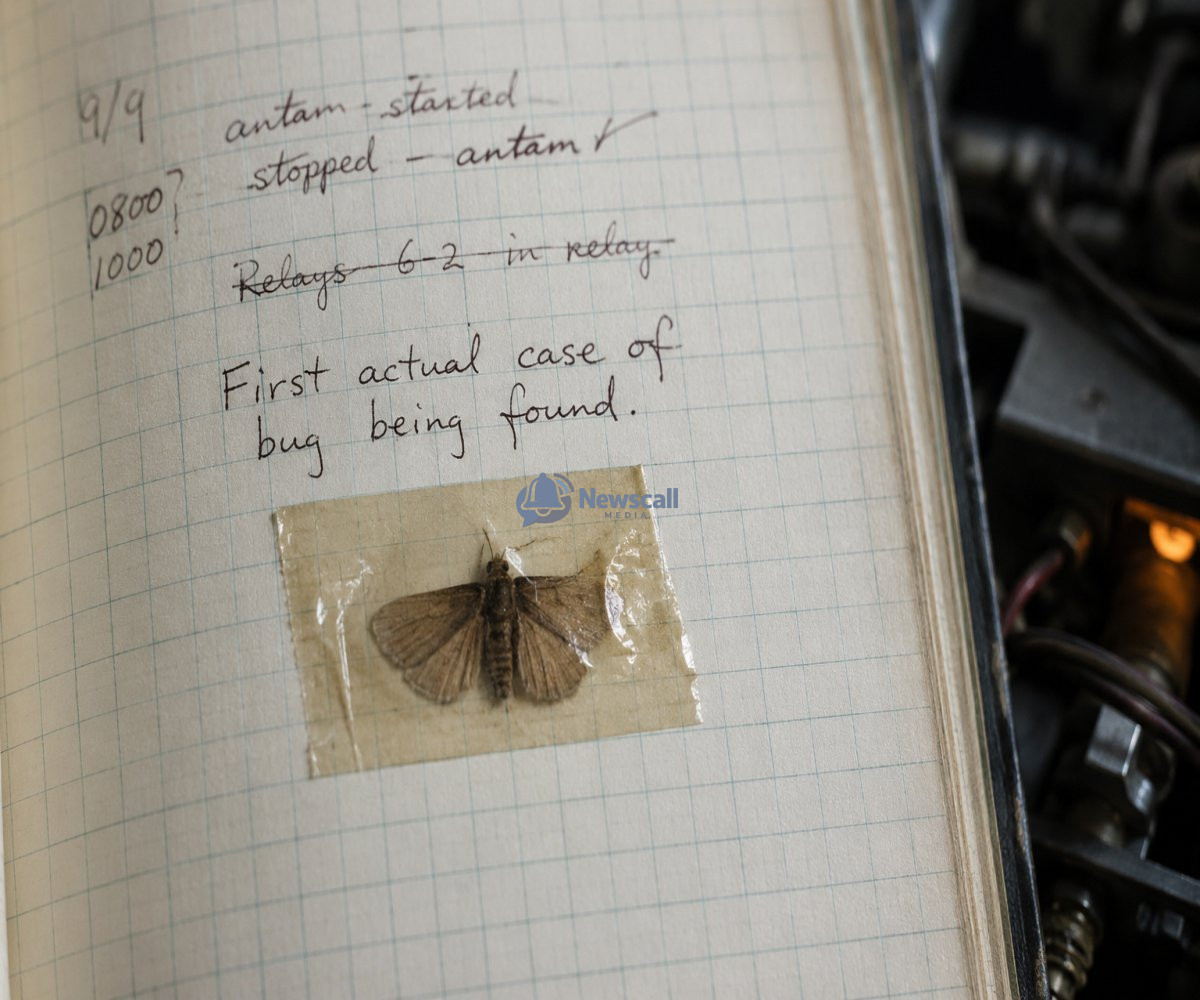
The engineers carefully removed the moth and taped it into their logbook.
Next to it, they wrote a now-famous note:
"First actual case of bug being found."
The moth itself wasn't the origin of the term "bug."
Engineers had used the word long before computers existed.
Inventors and technicians often referred to unexpected mechanical problems as bugs.
Even the famous inventor Thomas Edison used the term in the late nineteenth century when describing technical difficulties.
What made the Harvard incident special was that it involved a literal insect causing a technical malfunction.
The joke was too perfect to ignore.
The story quickly spread throughout engineering and computing circles.
Over time, the term became deeply embedded in computer culture.
Today, when software behaves unexpectedly, programmers still call it a bug.
Even though the problem usually has nothing to do with insects.
The irony is that modern bugs are often far more difficult to find than the original moth.
A trapped insect can be removed in seconds.
A software bug might hide among millions of lines of code.
Some can remain undiscovered for years.
Others have caused major outages, financial losses, and even space mission failures.
Yet the principle remains the same.
Something small creates a much bigger problem.
That's one reason the story continues to fascinate people.
It reminds us that even the most advanced technologies can be brought down by surprisingly simple causes.
A tiny insect managed to interrupt one of the world's most sophisticated machines.
Not through intelligence.
Not through planning.
Just by being in the wrong place at the wrong time.
More than seventy years later, programmers around the world still spend their days fixing bugs.
Most have never seen a moth inside a computer.
But every time they debug a program, they're using a piece of terminology connected to one of the most famous incidents in technology history.
A reminder that sometimes the stories behind our everyday words are just as fascinating as the technologies themselves.

Victor Oluebubechukwu Akuma.
Creative writer