

What Would Happen If Earth Suddenly Stopped Spinning?
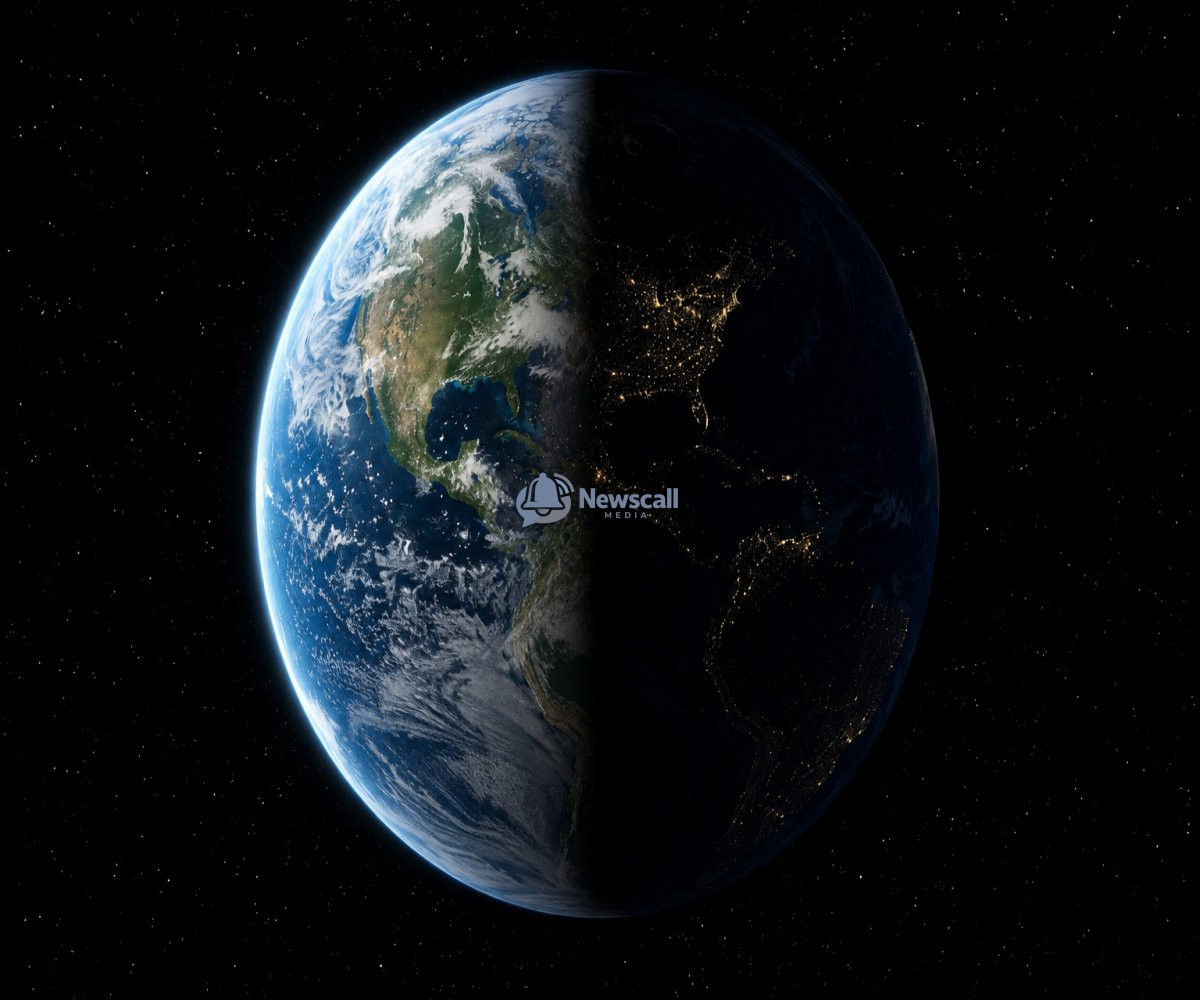
Right now, you're moving at an incredible speed.
You probably don't even think about it.
Yet every person on Earth is traveling through space as our planet rotates on its axis.
At the equator, the Earth's surface moves at roughly 1,670 kilometers per hour.
That's faster than the speed of sound.
And yet everything feels perfectly still.
But what if that suddenly changed?
What if, in an impossible instant, Earth stopped spinning?
The answer is one of the most terrifying thought experiments in science.
The first thing to understand is that stopping the Earth isn't the same as stopping everything on it.
According to physics, objects in motion tend to stay in motion unless acted upon by another force.
Even if the planet stopped rotating instantly, the atmosphere, oceans, buildings, vehicles, and people would still be moving eastward at their original speed.
That means nearly everything not firmly attached to bedrock would continue traveling at hundreds or even thousands of kilometers per hour.
Imagine standing outside when this happened.
The ground beneath your feet would stop.
You wouldn't.
The result would be catastrophic.
People, cars, trees, and entire structures would be thrown eastward at enormous speeds.
The force would be comparable to the most violent natural disasters ever recorded.
Buildings would collapse.
Forests would be flattened.
Entire cities would be devastated within moments.
But that would only be the beginning.
The atmosphere would continue moving too.
Air that had been rotating with the Earth would suddenly race across the surface at tremendous speeds.
Global winds could exceed 1,600 kilometers per hour in some regions.
For comparison, the strongest hurricanes on Earth rarely exceed 300 kilometers per hour.
These winds would be several times stronger.
The atmosphere itself would become a weapon.
Massive storms would sweep across continents.
Debris would fill the air.
Entire landscapes could be reshaped.
The oceans would fare no better.
Water possesses momentum just like everything else.
When the Earth stopped, oceans would continue moving.
Gigantic megatsunamis would surge across coastlines.
Walls of water hundreds of meters high could sweep inland, destroying everything in their path.
Many of the world's largest cities are located near coastlines.
They would face unimaginable destruction.
Yet the consequences would extend far beyond the initial chaos.
Earth's rotation affects the shape of the planet itself.
Most people assume Earth is a perfect sphere.
It isn't.
Because of rotation, our planet bulges slightly around the equator.
The centrifugal force created by spinning pushes material outward.
If Earth stopped rotating, that bulge would gradually disappear.
Water currently distributed around the equator would begin migrating toward the poles.
Entire coastlines would change.
Some regions currently underwater might emerge as land.
Other areas could become submerged beneath newly formed oceans.
The map of the world would look dramatically different.
Countries would gain and lose territory.
Geography itself would be rewritten.
The length of a day would also change.
Currently, Earth rotates once approximately every twenty-four hours.
That's what creates our familiar cycle of day and night.
Without rotation, one full day would last an entire year.
One side of the planet would face the Sun for months.
The other side would remain in darkness for months.
Temperatures would become extreme.
The sunlit side could become unbearably hot.
The dark side could become brutally cold.
Many ecosystems would struggle to survive such conditions.
Agriculture would be transformed.
Weather patterns would collapse and reorganize.
Entire species might disappear.
Earth's magnetic field could also be affected.
The magnetic field is generated largely by the movement of molten metals within the planet's outer core.
While stopping Earth's surface rotation wouldn't necessarily eliminate the magnetic field immediately, it could alter complex processes that help sustain it over long periods.
Without a strong magnetic shield, the planet would become more vulnerable to harmful solar radiation.
Life would face additional challenges.
Even satellites and modern technology could be affected.
Many systems we rely on assume a rotating Earth.
Navigation, communication, weather forecasting, and countless other technologies would require major adjustments.
Civilization as we know it would struggle to adapt.
Of course, there is some good news.
This scenario is essentially impossible.
No known natural process could suddenly stop Earth's rotation.
The amount of energy involved is almost beyond comprehension.
Earth contains an enormous amount of rotational momentum
Halting it instantly would require forces far beyond anything humanity can produce.
Even massive asteroid impacts wouldn't simply bring the planet to a stop.
The laws of physics protect us from such a sudden catastrophe.
In reality, Earth's rotation is actually slowing down very gradually.
The Moon exerts tidal forces that act like a tiny brake on our planet.
As a result, Earth's days become slightly longer over millions of years.
But the change is incredibly small.
You won't notice it.
Neither will your children, grandchildren, or countless generations after them.
The process is measured in milliseconds over centuries.
Nothing like the dramatic scenario described above will happen.
Still, thought experiments like this reveal something fascinating.
Many of the conditions we take for granted are surprisingly delicate.
The length of our days.
The behavior of our oceans.
The stability of our atmosphere.
The climate that supports life.
All depend on a planet spinning through space at extraordinary speed.
Most days, we never think about it.
We wake up.
Go to school or work.
Watch the sunset.
Sleep.
And repeat the cycle.
Yet beneath all of it lies an invisible motion that has shaped our world for billions of years.
Earth's rotation doesn't just determine when the Sun rises.
It influences weather, oceans, ecosystems, and life itself.
The fact that we rarely notice it may be the most remarkable thing of all.
Sometimes the most important forces in the universe are the ones we never feel.
#Science #Physics #Earth #Space #Astronomy #EarthScience #ScienceFacts #STEM #Education #Knowledge #Learning #PlanetEarth #Universe #Cosmos #ScientificDiscovery #DidYouKnow #SpaceFacts #FutureScience #PhysicsExplained #Curiosity

Victor Oluebubechukwu Akuma.
Creative writer