


Mirrors That Can Change Their Shape? The Science Sounds Impossible
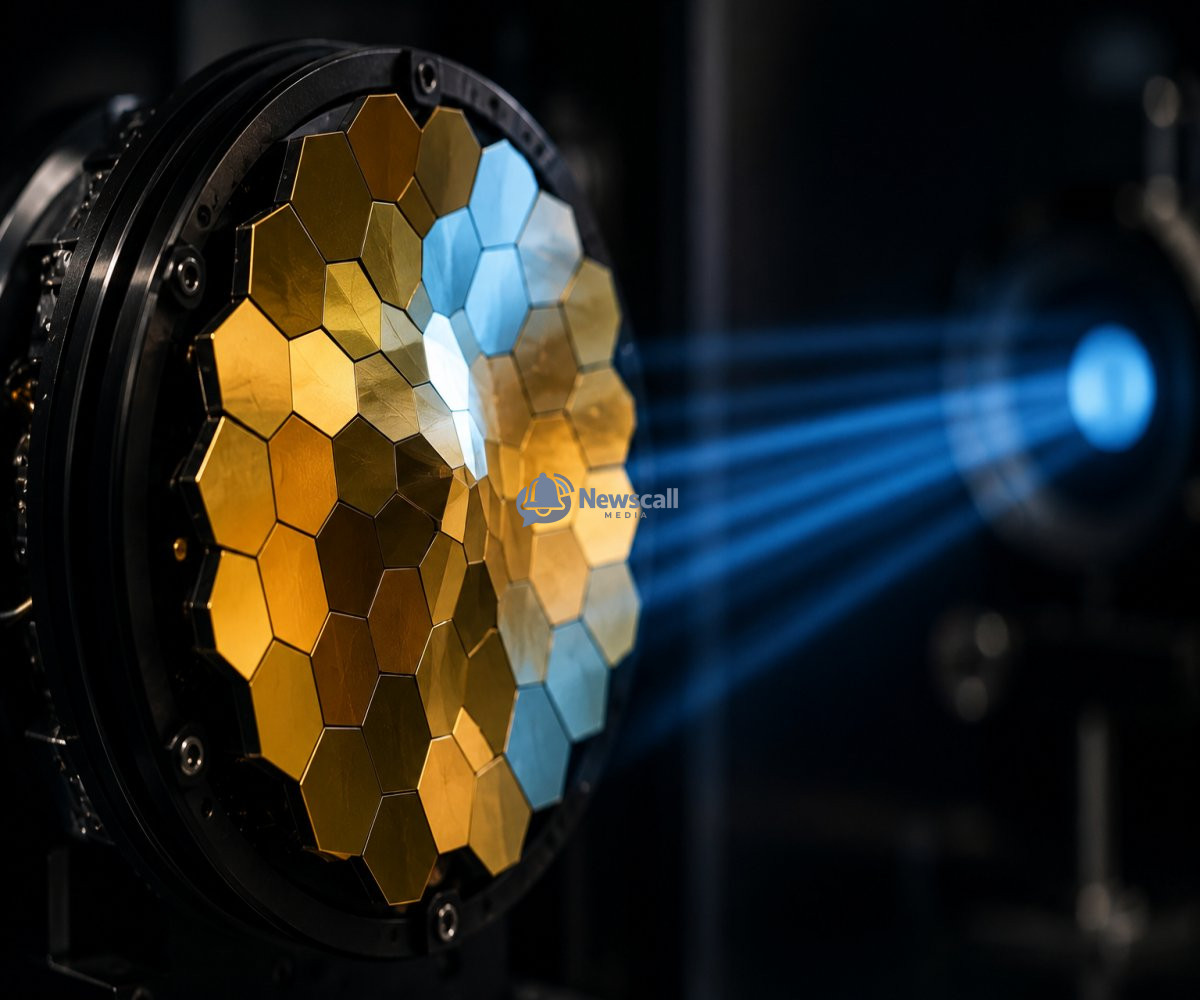
When most people think of a mirror, they imagine something simple.
A flat piece of glass that reflects whatever stands in front of it.
Once it's made, it never changes.
Or so it seems.
Hidden inside some of the world's most advanced telescopes, powerful lasers, and scientific instruments are mirrors that do something almost unbelievable.
They change their shape.
Not by bending with your hands or folding like metal, but by constantly reshaping themselves while they're being used.
It sounds like science fiction.
In reality, it's one of the most important technologies in modern engineering.
These remarkable devices are called deformable mirrors, though they're often described as shape-shifting mirrors because their surfaces continuously adjust to improve the quality of light passing through them.
The changes are almost impossible to imagine.
Instead of moving by millimeters, these mirrors shift by nanometers—or even picometers.
A picometer is one trillionth of a meter.
To put that into perspective, a human hair is roughly 80 million picometers wide.
The movements are so small that they are invisible to the human eye.
Yet they can completely transform what scientists are able to see.
Why would a mirror need to change its shape?
The answer lies in light.
As light travels through space or Earth's atmosphere, it becomes slightly distorted.
Tiny imperfections in telescope lenses, vibrations, temperature changes, and even moving air can alter the path of light before it reaches a camera or sensor.
Those distortions may be microscopic, but they can blur images enough to hide distant planets, stars, or fine details inside living cells.
A shape-shifting mirror solves that problem.
Attached to the back of the mirror are hundreds—or sometimes thousands—of tiny mechanical devices called actuators.
Each actuator pushes or pulls on the mirror's surface independently.
Working together, they reshape the mirror in real time.
The adjustments happen so quickly that some systems can update hundreds or even thousands of times every second.
Instead of accepting distorted light, the mirror actively corrects it.
The result is a much sharper image.
This technology is transforming astronomy.
Ground-based telescopes must constantly deal with Earth's atmosphere, which causes stars to appear as though they are twinkling.
While beautiful to our eyes, that same effect makes astronomical observations less clear.
Adaptive optics systems use shape-shifting mirrors to cancel out those distortions, allowing telescopes on Earth to produce images approaching the clarity of space telescopes.
NASA is also taking the technology into space.
The upcoming Nancy Grace Roman Space Telescope will use deformable mirrors as part of its powerful coronagraph instrument.
Their job will be to suppress the overwhelming brightness of distant stars, making it possible to directly observe faint planets orbiting around them.
Without shape-shifting mirrors, many of those planets would remain hidden in the glare of their parent stars.
The technology reaches far beyond astronomy.
Modern medicine uses adaptive optics to capture incredibly detailed images of the human retina, helping doctors detect eye diseases earlier than ever before.
Powerful laser systems rely on deformable mirrors to keep laser beams precisely focused over long distances.
Manufacturers use them to improve semiconductor production.
Even some defense and communication systems depend on the technology to maintain accurate optical performance.
Perhaps the most fascinating part is that these mirrors don't become smarter because they're made from unusual materials.
They become smarter because they never stop adapting.
Traditional mirrors remain fixed.
Shape-shifting mirrors constantly respond to changing conditions, correcting errors before they become problems.
In many ways, they behave less like ordinary mirrors and more like living systems that continuously adjust to their environment.
Their existence also reminds us that engineering breakthroughs aren't always about building something bigger.
Sometimes they're about making something more precise.
A mirror that changes by just a few trillionths of a meter may sound insignificant.
Yet those microscopic movements can reveal planets orbiting distant stars, improve life-saving medical scans, and sharpen our understanding of the universe.
The next time you look into an ordinary mirror, it may seem impossible that another mirror, built using the same basic principle, could quietly reshape itself thousands of times every second.
But somewhere inside a research laboratory or a space telescope, that's exactly what's happening.
And thanks to those invisible movements, humanity is seeing the universe more clearly than ever before.

Victor Oluebubechukwu Akuma.
Creative writer