

The Engineering Secret Of The Eiffel Tower
Today, millions of people look at the Eiffel Tower and see a symbol of Paris.
Some see romance.
Some see art.
Some see one of the most recognizable landmarks on Earth.
But when the tower was first proposed in the late nineteenth century, many people hated it.
Artists called it ugly.
Writers criticized its appearance.
Some even demanded that construction be stopped entirely.
Yet more than a century later, the Eiffel Tower still stands.
Not only has it survived, but it has also become one of the most successful engineering projects in human history.
The real question is why.
How has a structure built in the 1880s managed to withstand powerful winds, changing temperatures, storms, and the passage of time for more than a hundred years?
The answer lies in an engineering secret that was far ahead of its time.
To understand the tower's brilliance, we must first understand its creator.
The tower was designed by engineer Gustave Eiffel and his team for the 1889 World's Fair in Paris.
The event celebrated the hundredth anniversary of the French Revolution.
France wanted something extraordinary.
Something the world had never seen before.
Eiffel proposed a giant iron tower reaching approximately 300 meters into the sky.
At the time, this was astonishing.
No structure had ever been built so tall.
Many experts questioned whether it could even be done safely.
The greatest challenge wasn't weight.
It was wind.
Most people assume tall structures collapse because they are too heavy.
In reality, wind is often a much greater threat.
As a building grows taller, the force exerted by the wind increases dramatically.
Strong gusts can create enormous pressure.
If the design isn't correct, the structure may bend excessively, become unstable, or even fail.
Eiffel understood this problem better than almost anyone.
Instead of fighting the wind, he decided to work with it.
This became the tower's greatest engineering secret.
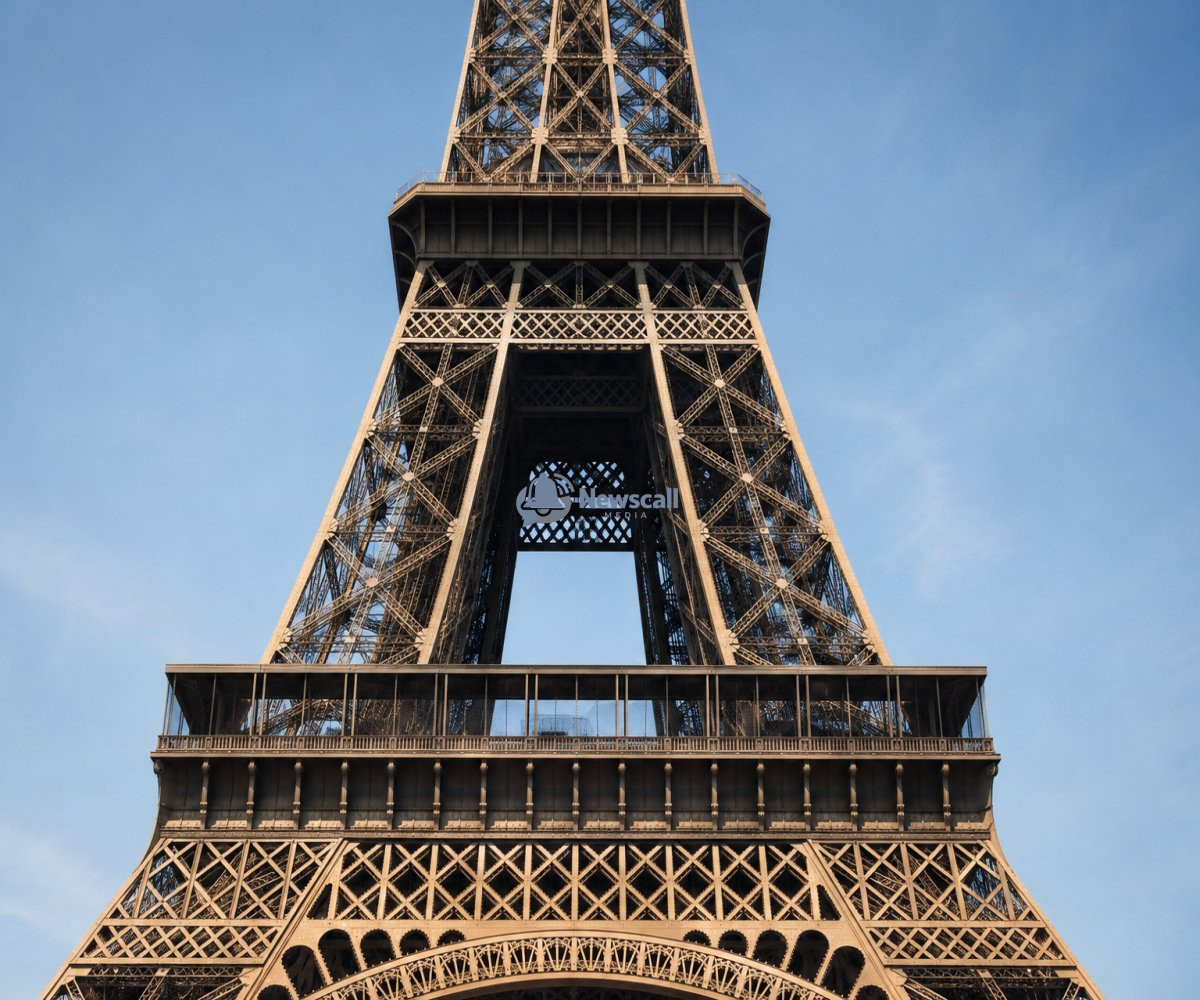
Look carefully at the Eiffel Tower.
Its shape isn't random.
The curved sides are not merely decorative.
Every line, every angle, and every section was carefully calculated.
The tower gradually narrows as it rises.
This shape allows wind forces to be distributed efficiently throughout the structure.
Rather than presenting a flat wall for the wind to push against, the tower allows air to flow around and through it.
In many ways, it behaves more like a giant skeleton than a solid building.
This is another reason the tower survives.
Most of the structure consists of open lattice ironwork.
More than 18,000 individual iron pieces are connected together using millions of rivets.
The spaces between the iron beams allow wind to pass through.
Instead of resisting the full force of a storm, the tower reduces the amount of force acting upon it.
Modern engineers still use similar principles when designing tall structures.
The Eiffel Tower was demonstrating them decades before skyscrapers became common.
Even more impressive was the mathematics involved.
Long before powerful computers existed, engineers had to perform calculations by hand.
Eiffel's team spent years studying how wind pressure would affect every part of the tower.
They calculated how forces would travel through the structure.
They analyzed stress points.
They estimated how much the tower would sway.
The result was astonishingly accurate.
Even during powerful winds, the top of the tower moves only a relatively small amount.
Visitors rarely notice it.
Yet that flexibility is actually part of the design.
A completely rigid structure can be dangerous.
When forces build up, something must give.
The Eiffel Tower solves this problem by allowing slight movement.
It bends just enough to absorb energy without suffering damage.
Modern skyscrapers use a similar strategy.
Some of the tallest buildings on Earth are designed to sway slightly during storms.
The movement feels strange, but it helps keep the structure safe.
The Eiffel Tower pioneered this concept long before most people understood its importance.
Temperature creates another challenge.
Iron expands when heated and contracts when cooled.
Since the tower is exposed to sunlight, its dimensions change throughout the year.
On hot summer days, parts of the structure become slightly larger.
During colder months, they shrink again.
Engineers anticipated this from the beginning.
The tower's design accommodates these changes naturally.
Without this consideration, repeated expansion and contraction could have damaged the structure over time.
Maintenance has also played a critical role in its survival.
Iron is vulnerable to corrosion.
Rain, humidity, and pollution can slowly weaken metal surfaces.
To prevent this, the tower is regularly repainted.
In fact, maintaining its protective coating is one of the most important tasks performed by engineers responsible for its preservation.
The famous color people associate with the Eiffel Tower isn't merely aesthetic.
It helps protect the structure itself.
Perhaps the most remarkable aspect of the tower is how modern its design still feels.
When construction began in 1887, automobiles were rare.
Airplanes didn't yet exist.
Computers were unimaginable.
Yet many of the engineering principles used in the Eiffel Tower remain relevant today.
Engineers still study how structures interact with wind.
They still design for flexibility.
They still optimize shapes to reduce stress.
They still account for temperature expansion.
In many ways, the tower was a glimpse into the future of structural engineering.
Ironically, the people who criticized the tower focused on its appearance.
History remembers something else entirely.
Its engineering.
What was once called an eyesore became one of the most admired structures in the world.
More than 130 years after its completion, the Eiffel Tower continues attracting millions of visitors every year.
Not because it is the tallest structure anymore.
Not because it is the newest.
But because it represents something timeless.
A perfect marriage of science, mathematics, and imagination.
The Eiffel Tower teaches an important lesson about engineering.
The strongest structures are not always the ones that resist every force.
Often, they are the ones designed to work with those forces.
Gustave Eiffel understood that better than most.
And that understanding is the secret that has kept his tower standing for generations.

Victor Oluebubechukwu Akuma.
Creative writer