

The Secret That Allows Rockets to Land Themselves: The Optimal Control Theory
For most of human history, rockets had one job.
Go up.
Once their fuel was exhausted, they either burned up in the atmosphere, crashed into the ocean, or became expensive pieces of space junk.
Then something changed.
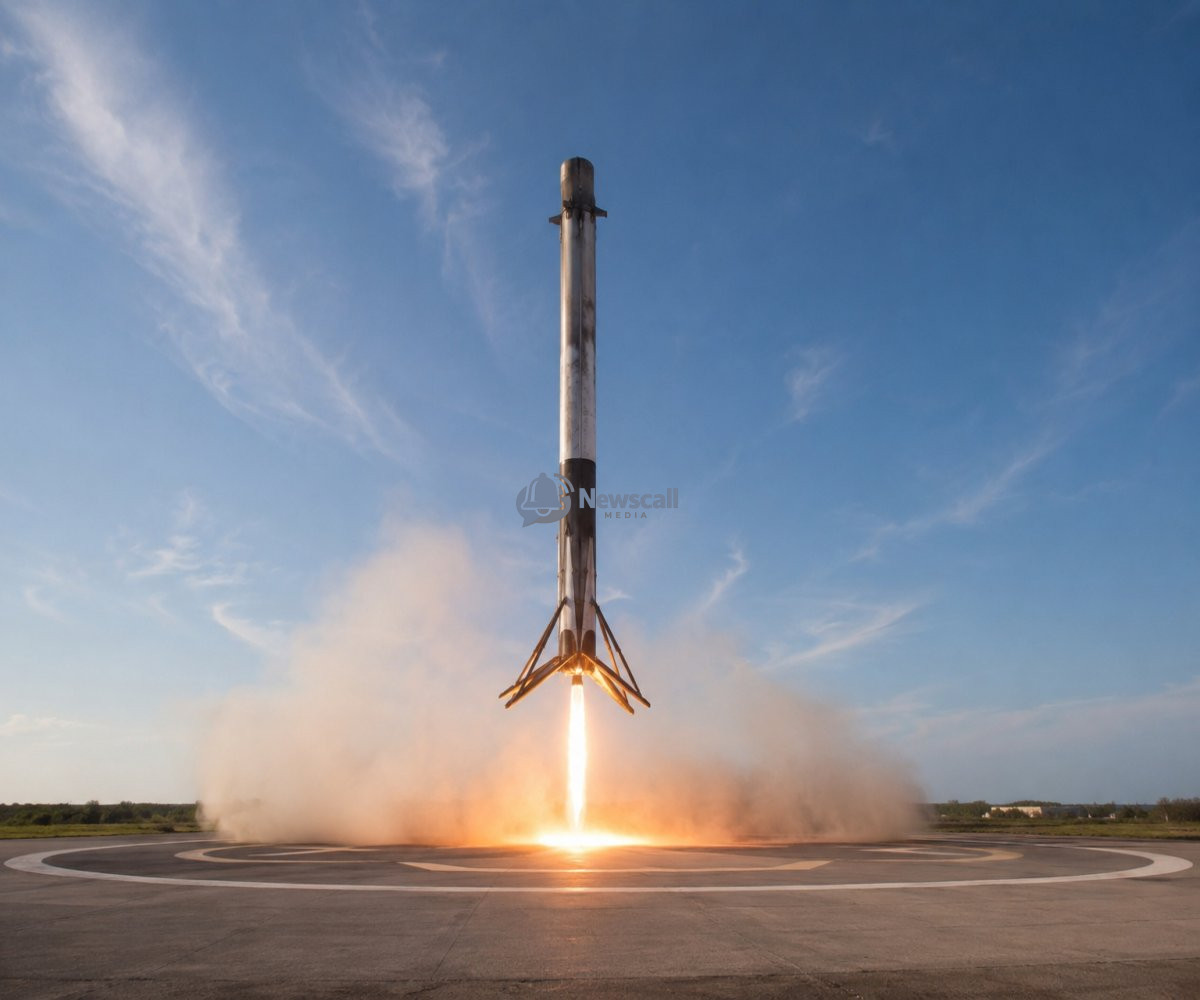
Today, rockets can launch into space, deliver their payload, return to Earth, and land upright with astonishing precision.
To many people, it looks like science fiction.
But behind every successful rocket landing lies one of the most important ideas in modern aerospace engineering.
The Problem Nobody Could Solve
Imagine throwing a pencil into the air.
Now imagine trying to make that pencil come back down and land perfectly upright on its tip.
Sounds impossible.
That's essentially the challenge engineers face when landing a rocket.
A rocket is moving at tremendous speeds. It is affected by gravity, wind, fuel consumption, changing mass, and atmospheric conditions.
A tiny mistake can send it crashing into the ground.
The question wasn't whether rockets could return.
The question was whether they could return accurately enough to be reused.
The Equation Behind the Magic
The breakthrough comes from a concept known as optimal control theory.
In simple terms, it's the mathematics of making the best possible decisions while a system is moving.
The rocket's computer constantly asks itself:
- Where am I?
- How fast am I moving?
- How much fuel do I have left?
- How much thrust should I apply?
- Which direction should I point?
Every second, thousands of calculations are performed to determine the most efficient path to a safe landing.
Instead of following a fixed route, the rocket continuously adjusts its behavior based on real-time conditions.
It's not following instructions.
It's solving a problem.
The Guidance Formula
One of the most famous techniques used in modern rocketry is called Powered Descent Guidance.
The idea is surprisingly elegant.
The rocket continuously calculates the difference between:
- Its current position
- Its desired landing position
The onboard computer then determines the exact engine thrust required to reduce that difference to zero.
In essence, the rocket is constantly correcting its own mistakes.
Every gust of wind.
Every unexpected movement.
Every tiny deviation.
The computer notices it and responds almost instantly.
Why Landing Is Harder Than Launching
Most people assume launching a rocket is the difficult part.
In reality, landing can be even more challenging.
During launch, the goal is simple:
Go up.
During landing, the rocket must:
- Slow down dramatically
- Maintain balance
- Control its orientation
- Conserve fuel
- Reach a precise target
All at the same time.
Imagine trying to park a car while falling from the sky.
That's closer to the challenge engineers face.
The Grid Fin Solution
If you've watched videos of modern rocket landings, you may have noticed strange metal structures sticking out from the sides.
These are called grid fins.
Think of them as the rocket's steering system.
As the rocket falls back through the atmosphere, the fins interact with the air to help control direction and stability.
Without them, the rocket would struggle to maintain accuracy during descent.
Why This Changes Everything
The real innovation isn't the landing itself.
It's what the landing makes possible.
For decades, rockets were treated like disposable products.
Imagine buying a new airplane after every flight.
The costs would be enormous.
Reusable rockets changed that equation completely.
By recovering and reusing boosters, launch providers can dramatically reduce the cost of reaching space.
What once cost hundreds of millions of dollars can become significantly cheaper.
This opens the door to more satellites, more scientific missions, more exploration, and potentially even future settlements beyond Earth.
The Bigger Lesson
Rocket landings aren't just a triumph of engineering.
They're proof that some of the world's biggest breakthroughs come from solving problems people once considered impossible.
The secret isn't a special fuel.
It's not a revolutionary engine.
It's mathematics, software, and relentless engineering working together.
Every time a rocket lands upright on a floating platform or launch pad, we're witnessing millions of calculations transforming what was once science fiction into reality.
And perhaps that's the most remarkable part of all.
The future often looks like magic—until you understand the science behind it.

Victor Oluebubechukwu Akuma.
Creative writer