

These Underwater Kites Could Turn Slow Ocean Currents Into Electricity
Kites usually need two things to work: wind and open sky.
But engineers are now building a very different kind of kite—one that never sees the sky, never catches a gust of wind and spends its entire life underwater.
Instead of floating with the current, these machines "fly" through it.
And that strange idea could open up a new way of generating renewable electricity from one of Earth's most predictable energy sources: the movement of the ocean.
Tidal energy has always had an obvious advantage over solar and wind power.
The tides are predictable.
We know when they will rise and fall, and we can calculate how water will move through many coastal channels and straits. The problem is that extracting useful electricity from those currents is not always easy.
Traditional tidal turbines generally need relatively strong currents to operate economically. Installing large turbines on the seabed can also be expensive, particularly in deep or remote waters.
This is where underwater kites become interesting.
The basic concept looks surprisingly simple.
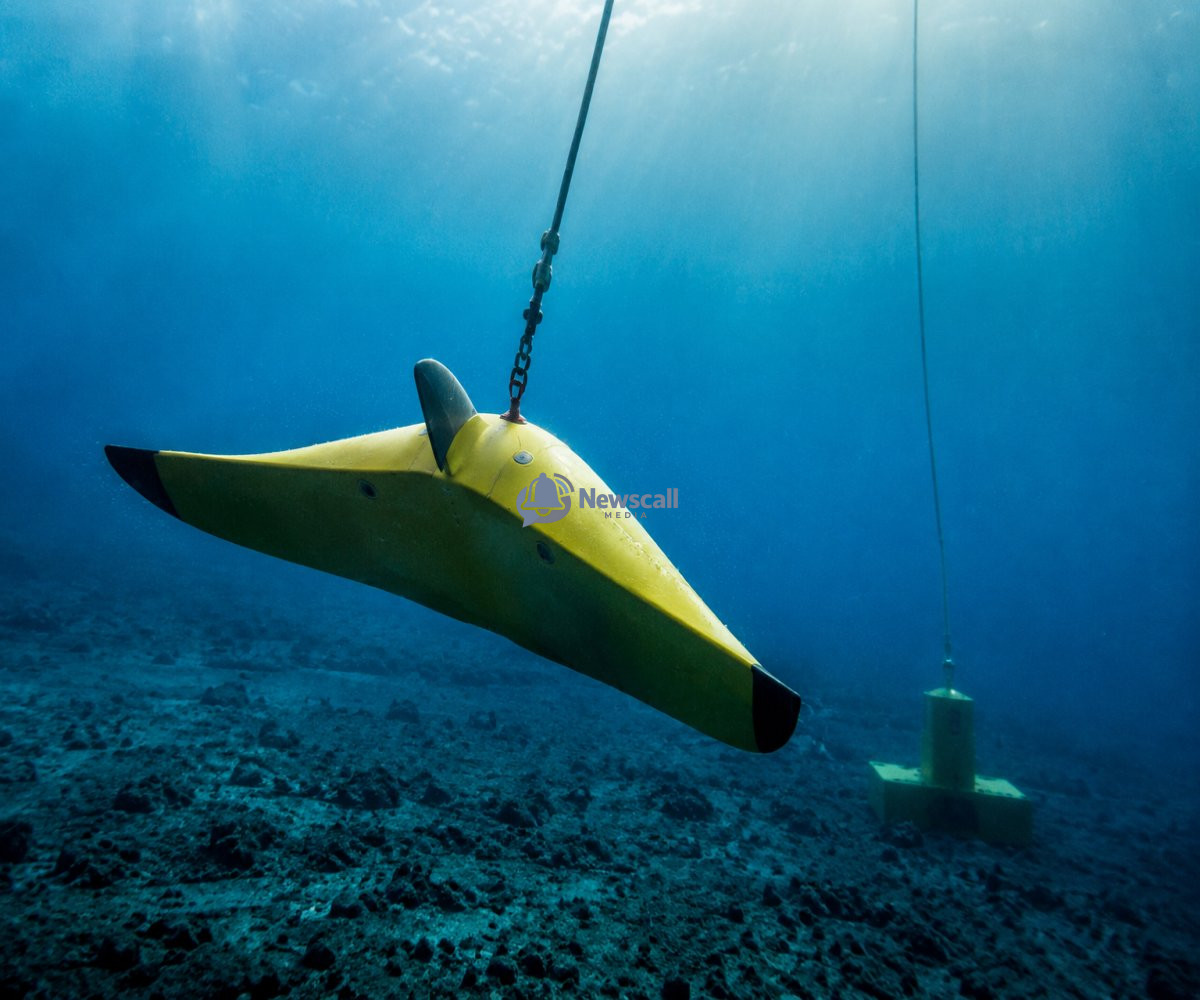
A kite-shaped underwater wing is attached to the seabed by a tether. Instead of allowing the current to push it in a straight line, onboard controls guide the kite through repeated figure-eight patterns.
The wing generates hydrodynamic lift, much like an aircraft wing moving through air.
As the kite sweeps across the current, its motion through the water can become several times faster than the water itself is moving.
That additional speed is the secret.
A slow-moving current may not contain enough useful energy for a conventional fixed turbine. But an underwater kite can use the current to accelerate its own motion across a much larger path, allowing it to extract energy more effectively from relatively slow flows.
Think of it like this.
A conventional turbine sits in the water and waits for the current to push through its blades.
An underwater kite moves through the current.
It is not simply harvesting the water's movement—it is using the water's movement to create a much faster movement of its own.
That is why the technology has attracted researchers and energy companies.
One of the companies furthest along with the concept is Swedish marine-energy company Minesto.
Its system, called Deep Green, uses a wing-shaped underwater vehicle attached to the seabed. The vehicle follows a controlled trajectory through the water while an onboard turbine converts the resulting motion into electricity.
Minesto says its technology is designed to operate in relatively slow tidal streams, with its current systems targeting flows around 1.2 metres per second. The company has also demonstrated a commercial-scale 500-kilowatt system and has developed the larger Dragon-class systems for tidal power generation.
The technology has already moved beyond laboratory demonstrations.
Minesto's Dragon 12, a roughly 12-metre-wide tidal kite, has generated electricity for the grid in the Faroe Islands.
The machine operates underwater, tethered to the seabed, and uses its controlled flight path to drive its turbine.
That makes the concept particularly interesting for islands and coastal regions where land is limited and imported fuel can be expensive.
But Minesto isn't the only group exploring underwater kites.
Researchers at SRI International and the University of California, Berkeley are developing another system called Manta, designed specifically with smaller coastal communities in mind.
Instead of putting a turbine directly on the underwater kite, Manta uses the kite's movement to pull on a tether connected to a generator.
As the kite travels outward through the current, it generates electricity. The system then uses a small amount of energy to reel the kite back in before beginning another cycle.
It works somewhat like an enormous underwater yo-yo.
But there is an important engineering problem.
The kite has to keep flying.
That sounds obvious until you consider what is happening underwater.
The machine has to continuously control its position, orientation and speed while responding to changing currents and generator loads.
Modern sensors and onboard electronics allow the system to autonomously control its trajectory, with the kite sweeping through repeated figure-eight patterns.
SRI's Manta project has already undergone testing in San Francisco Bay.
A one-metre-wing-span prototype was able to drive a small generator and produced more than 100 watts during peak tidal flows of about 1.5 metres per second.
The team is now evaluating a larger pilot system with a two-metre wingspan and a 15-metre tether. Simulations suggest that this version could average around one kilowatt over an entire tidal cycle, including periods when the current falls below one metre per second.
One kilowatt might not sound impressive when compared with a power plant.
But the objective isn't necessarily to replace a power station.
For a remote coastal community currently dependent on diesel generators, a relatively small renewable energy system can make a meaningful difference.
That's one reason SRI is testing Manta for potential use in Alaska, where some remote communities depend heavily on diesel for electricity.
Unlike sunlight, tidal currents do not disappear at night.
And unlike wind, tides can be predicted years in advance.
That predictability could make tidal energy a useful complement to solar and wind in places where all three resources are available.
There is another advantage hiding beneath the surface.
Water is much denser than air.
That means an underwater wing can interact with a tremendous amount of energy even when the water itself is moving relatively slowly. Researchers at the University of Michigan have found that cross-current motion can allow kite-based systems to produce substantially more power per unit of wing area than comparable fixed turbines.
This could potentially allow marine-energy systems to become smaller and lighter without sacrificing as much energy production.
And because the kite is attached to the seabed with a tether rather than sitting on a massive tower or foundation, the infrastructure can potentially be simpler.
That matters because one of the biggest challenges facing marine renewable energy is cost.
The ocean is an incredibly powerful environment, but it is also an unforgiving one.
Salt water causes corrosion.
Waves and currents place enormous forces on structures.
Installing and maintaining equipment underwater can require specialised vessels and crews.
Every kilogram of equipment and every complicated component can increase the cost of a project.
The underwater-kite approach attempts to address some of those challenges by getting more useful motion from less physical infrastructure.
But the technology is far from finished.
The biggest challenge may actually be control.
An underwater kite has to continuously adjust its flight path. Researchers describe the control problem as involving multiple degrees of freedom, meaning the system has to manage several aspects of its movement simultaneously.
If the kite loses control, its energy production can fall sharply—or the system could potentially place excessive loads on its tether or other components.
There are also questions about marine ecosystems, reliability, underwater maintenance and whether these systems can operate economically for years rather than months.
And although tidal energy is predictable, it is not available everywhere at a useful economic level.
The technology works best in places where currents are strong enough to provide meaningful energy but not necessarily strong enough to justify—or support—the economics of conventional turbines.
That is precisely the gap underwater kites are trying to fill.
Researchers are also looking beyond tides.
The same principle can potentially be applied to ocean currents and river flows.
A 2026 study published in Renewable Energy examined a tethered undersea kite turbine and modelled how its movement through ocean currents could be used to increase energy extraction. The researchers reported a simulated average power output of 383 kilowatts for one optimised configuration.
Simulation results are not the same thing as commercial performance, but they show how seriously engineers are investigating the concept.
And the potential market is much larger than it first appears.
The world's oceans are constantly moving.
Tides push enormous quantities of water through narrow channels twice a day. Ocean currents move water across entire regions of the planet. Rivers carry huge amounts of kinetic energy toward the sea.
Humanity has spent centuries learning how to extract energy from moving water.
Hydroelectric dams capture the energy of rivers.
Tidal turbines capture the movement of seawater.
Wave-energy systems attempt to capture the motion of the ocean surface.
Underwater kites represent another approach: instead of building enormous stationary machines and waiting for the water to pass through them, build machines that actively move through the water.
That shift in thinking could be important.
The future of renewable energy may not simply be about building bigger turbines, larger solar farms or taller wind turbines.
It could also be about designing smarter machines that extract more energy from environments that previously seemed too weak or too difficult to exploit.
An underwater kite may look strange compared with a conventional power plant.
There is no giant tower.
No spinning blades are visible from the shore.
No solar panels cover the landscape.
There is simply a wing moving silently beneath the water, following a carefully calculated path while a generator turns its motion into electricity.
And that may be the most fascinating part.
The ocean has always been moving.
The tides have been rising and falling for millions of years.
We are only beginning to develop machines clever enough to follow that movement and turn it into useful power.
If engineers can make these systems reliable, affordable and environmentally responsible, the future of renewable energy could include something that sounds almost absurd today:
kites flying underwater, generating electricity from the movement of the sea.

Victor Oluebubechukwu Akuma.
Creative writer