

AI Is Creating Materials Scientists Never Thought To Look For
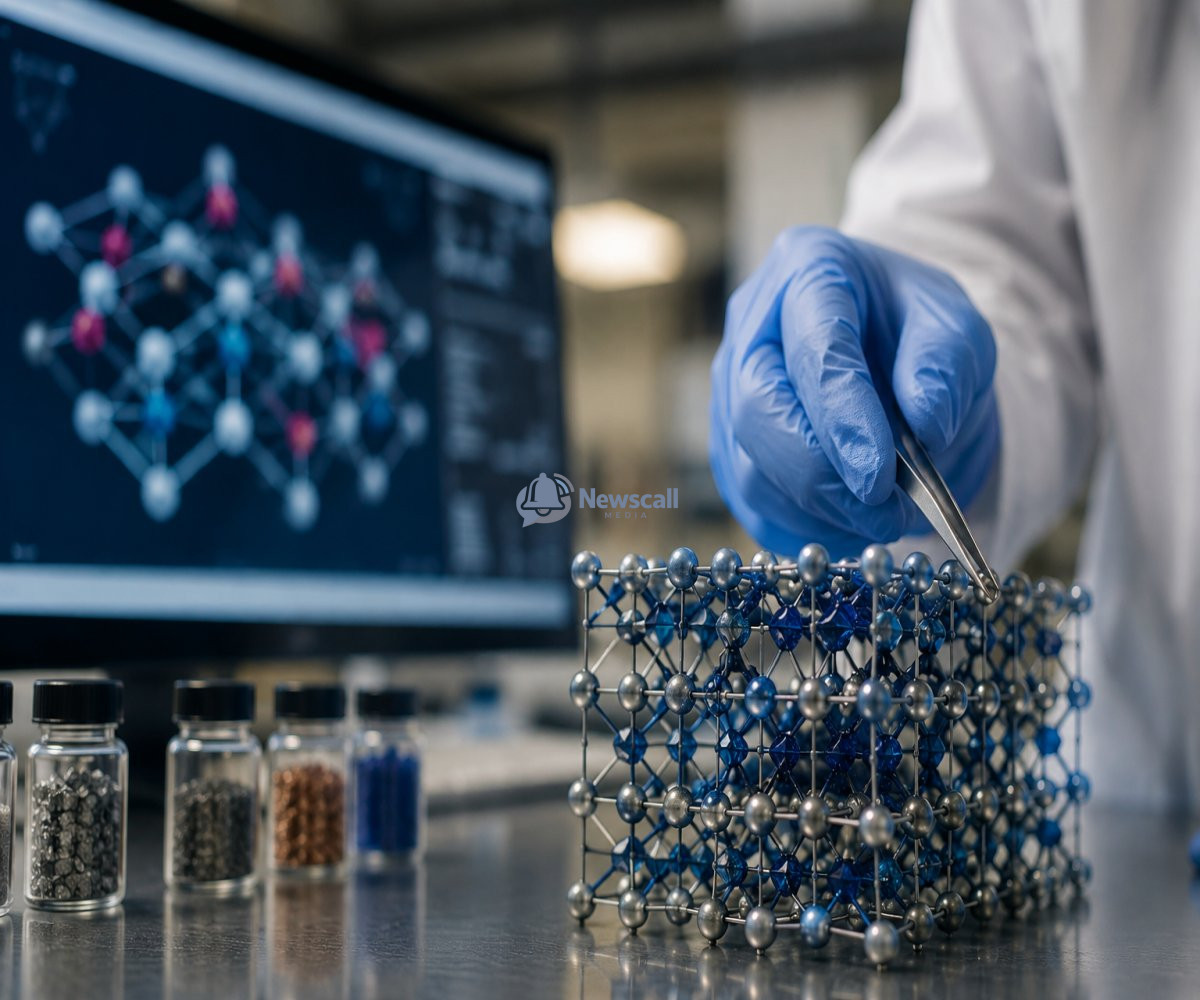
For centuries, discovering a new material meant experimenting with what already existed. Scientists would combine elements, change temperatures, alter structures, run experiments, record failures, and try again. It could take years to find something genuinely useful. Artificial intelligence is beginning to change that. Researchers are now using AI to search through enormous numbers of possible materials and identify candidates that humans may never have thought to investigate. The surprising part is that some of these materials aren't sitting in a laboratory somewhere waiting to be discovered. They don't exist yet. They exist as possibilities inside a computer. And scientists are now trying to turn those possibilities into reality. One of the biggest breakthroughs came from Google's DeepMind, which developed an AI system called GNoME to predict the structures of potentially stable crystals. The system identified millions of possible materials, including hundreds of thousands that researchers considered promising enough to investigate further. The scale is difficult to imagine. A human research team can only test a limited number of possibilities. An AI system can search through millions. But predicting a material isn't the same as creating one. That's where the next part of the revolution begins. Researchers are connecting AI systems to automated laboratories. Instead of an AI simply suggesting an interesting material and handing the idea to a scientist, software can help decide what experiment should happen next. Robotic equipment can then attempt to produce the material and measure the result. The information goes back into the system. The AI learns from the experiment and proposes another one. Then the process repeats. AI predicts. Robots experiment. AI learns. And it can happen far faster than a traditional research process. Scientists at Oak Ridge National Laboratory recently demonstrated an autonomous materials-synthesis system capable of exploring certain material processes dramatically faster than conventional approaches. The significance isn't simply that a robot can perform an experiment. It's that the machine can become part of the scientific decision-making loop. That opens up a completely different way of discovering materials. Traditionally, scientists often start with materials they already know and ask what they can do with them. AI allows researchers to approach the problem from the opposite direction. Start with the result you want. Then search for a material that could produce it. Need a material that can withstand extreme temperatures? Search for one. Need a material with unusual electrical properties? Search for one. Need something that could improve batteries, semiconductors, catalysts, or energy systems? Search through millions of possibilities. This approach is known as inverse design, and AI is particularly well suited to it because the number of possible combinations can become enormous. The potential applications are huge. Better materials could lead to batteries that store more energy. New semiconductor materials could help engineers build more powerful and efficient electronics. Advanced catalysts could make industrial processes cheaper or cleaner. Specialized materials could eventually be useful in extreme environments, including space exploration and advanced energy systems. But perhaps the most interesting consequence is what this could do to scientific discovery itself. Scientists are limited by human intuition. Even the world's best researchers cannot consider every possible combination of atoms and structures. AI doesn't have that limitation in the same way. It can explore possibilities that would be impractical for humans to examine individually. That doesn't mean AI automatically understands which discoveries matter. It can still make incorrect predictions. A material that looks promising in a simulation may be impossible to manufacture. Another might technically work but be too expensive to produce. And some predicted materials may turn out to have properties that are less impressive in reality. That's why physical experiments remain essential. The real breakthrough isn't AI replacing the laboratory. It's AI and the laboratory working together. Imagine a research system that never has to stop searching. During the day, it analyzes existing scientific data. It proposes new materials. Robotic equipment tests them. The results are automatically fed back into the system. The AI learns what worked and what didn't. Then it chooses the next experiment. Instead of scientists manually moving from experiment to experiment, the process becomes a continuous discovery engine. This is one reason the technology is attracting attention from startups. Materials discovery is an enormous business opportunity because a single breakthrough material can create an entirely new market. A better battery material could transform energy storage. A better semiconductor material could change computing. A new industrial catalyst could change manufacturing. The companies that discover those materials could potentially become extremely valuable. That makes AI-powered materials science very different from the typical AI startup race. The goal isn't necessarily to build another chatbot. The goal is to discover something that physically changes what humans can build. And the implications go beyond business. Human civilization has repeatedly been transformed by new materials. Bronze changed ancient societies. Steel transformed construction and transportation. Silicon became the foundation of modern computing. Lithium-ion batteries helped create the smartphone and electric-vehicle industries. The next major material could enable a technology that doesn't even exist yet. And AI could help us find it. That is the part worth paying attention to. We normally think of AI as something that generates text, images, code, or answers. But increasingly, AI is moving into the physical world. It's helping design drugs. It's assisting engineers. It's controlling robots. And now, it's being used to search for materials that humans haven't discovered. The future of AI may therefore be much bigger than digital content. It could eventually influence the physical objects around us. The computer you're reading this on. The battery powering it. The materials inside its processor. The machines manufacturing it. All of them could someday contain materials discovered with the help of artificial intelligence. The most important material of the next decade might not have been discovered yet. It might not even have a name. It could currently exist only as a prediction inside an AI system, waiting for a scientist—or a robot—to make it real. And when that happens, AI won't just have predicted something new. It will have helped create something the world had never seen before.

Victor Oluebubechukwu Akuma.
Creative writer