

EYES OF THE MACHINE: How Facial Recognition Technology Sees You Without Seeing You
Somewhere between science and surveillance, between convenience and controversy, lies a technology that no longer needs your password, your ID card, or even your permission to understand who you are.
It just needs your face.
Facial recognition technology is a system that identifies or verifies a person using their facial features. At first glance, it feels almost magical—like a phone unlocking itself the moment you look at it. But underneath that smooth experience is a chain of mathematics, pattern recognition, and machine learning models trained on millions of human faces.
It all begins with detection.
Before a system can recognize a face, it must first find one. Using computer vision, the algorithm scans an image or video frame and isolates regions that likely contain a face. It looks for patterns: the symmetry of eyes, the curve of a jaw, the spacing between key features. Modern systems rely on deep learning models trained to detect these patterns even under poor lighting, angles, or partial obstruction.
Once a face is detected, the real transformation begins.
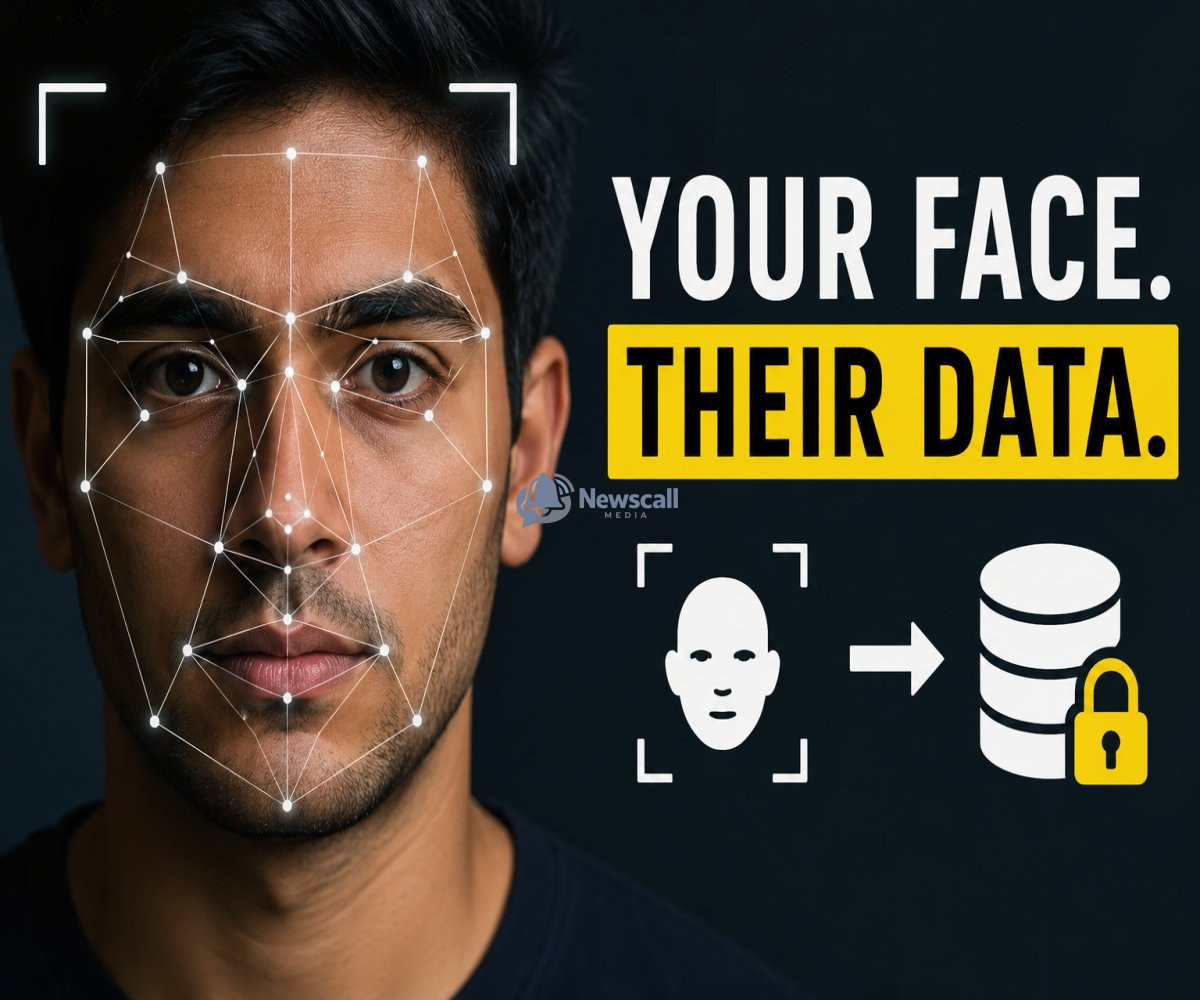
The system converts the face into a mathematical map. Not an image anymore, but a set of numerical values called a “face embedding.” Think of it as a unique digital fingerprint generated from your facial structure—distance between eyes, shape of cheekbones, contour of lips, depth of eye sockets, and dozens more subtle measurements that humans rarely consciously notice.
This is where deep neural networks take over. Trained on massive datasets, they learn to compress a face into a compact vector—often hundreds of numbers long. Faces that belong to the same person produce vectors that are close together in this mathematical space. Different people produce vectors far apart.
Recognition happens through comparison.
When you unlock a phone or pass through a security gate, the system compares your live face embedding with stored embeddings in a database. It uses similarity metrics—often cosine similarity or Euclidean distance—to determine how closely they match. If the match crosses a defined threshold, access is granted. If not, it is rejected.
But the system is not perfect. And that imperfection is where both innovation and concern live.
Lighting changes can distort accuracy. Facial expressions can slightly shift embeddings. Age, makeup, beards, masks, and even camera quality can affect performance. More critically, bias can creep in if the training data is not diverse enough, leading to uneven accuracy across different populations.
Despite this, facial recognition has spread rapidly across industries.
It unlocks smartphones. It powers airport security systems. It tags people in photos. It helps law enforcement identify suspects. It verifies identities in banking and online services. In some cities, it even tracks attendance or controls access to buildings.
What makes it powerful is also what makes it sensitive: it requires no physical interaction. You do not hand it anything. You do not sign anything. You simply exist in its field of view.
And it remembers.
As the technology evolves, newer systems are moving beyond simple recognition. They are learning to estimate emotion, predict attention, and analyze behavior patterns. This pushes facial recognition from identification into interpretation—a shift that raises deeper ethical questions about privacy, consent, and surveillance.
At its core, facial recognition is not about faces alone. It is about turning human identity into data, and data into decisions made in milliseconds by machines we rarely see but constantly encounter.
The question is no longer whether the technology works.
It does.
The question is what happens when everything works too well.

Victor Oluebubechukwu Akuma.
Creative writer