

The Machine That Helped Win World War II — And Gave Birth To The Digital Age
Long before smartphones, laptops, and the internet existed, a secret machine sat inside a heavily guarded British estate.
Few people knew it existed.
Fewer understood how important it was.
Its work was so secret that much of the world wouldn't learn about it for decades.
Yet many historians believe this machine helped shorten World War II and laid the foundation for the modern computer age.
The machine was called Colossus.
And its story is one of the most fascinating chapters in the history of technology.
To understand why Colossus mattered, we first need to understand the problem it was built to solve.
During World War II, military success often depended on information.
Armies needed to know enemy plans.
Navies needed to know where ships were moving.
Governments needed intelligence before making critical decisions.
The challenge was that all of this information was transmitted through encrypted messages.
The Germans relied heavily on advanced encryption systems to protect their communications.
Most famous was the Enigma machine, a device that scrambled messages into seemingly meaningless text.
But there was another system that was even more sophisticated.
The Lorenz cipher.
Unlike Enigma, which was often used for battlefield communications, Lorenz was reserved for some of the highest levels of German military command.
Messages sent through Lorenz carried information between senior leaders and military headquarters.
Breaking these messages could provide enormous strategic advantages.
The problem was that Lorenz encryption was incredibly complex.
The number of possible settings was astronomical.
Trying every possibility by hand would take an impractical amount of time.
A faster solution was needed.
This challenge led British codebreakers to one of the most secret locations of the war: Bletchley Park.
At Bletchley Park, mathematicians, engineers, linguists, and cryptanalysts worked together to break enemy codes.
Among them was the brilliant mathematician Alan Turing, whose contributions to computing would later become legendary.
But when it came to the Lorenz cipher, another breakthrough was required.
Engineer Tommy Flowers proposed something radical.
Instead of relying on mechanical systems, he suggested building an electronic machine capable of processing information at unprecedented speeds.
At the time, many experts doubted the idea.
Electronic components were often considered unreliable.
Vacuum tubes, the technology available at the time, had a reputation for failing frequently.
Building a machine containing thousands of them seemed risky.
Flowers disagreed.
He believed that properly designed electronic systems could operate reliably.
After months of work, his team produced Colossus.
When it became operational in 1944, it was unlike anything the world had ever seen.
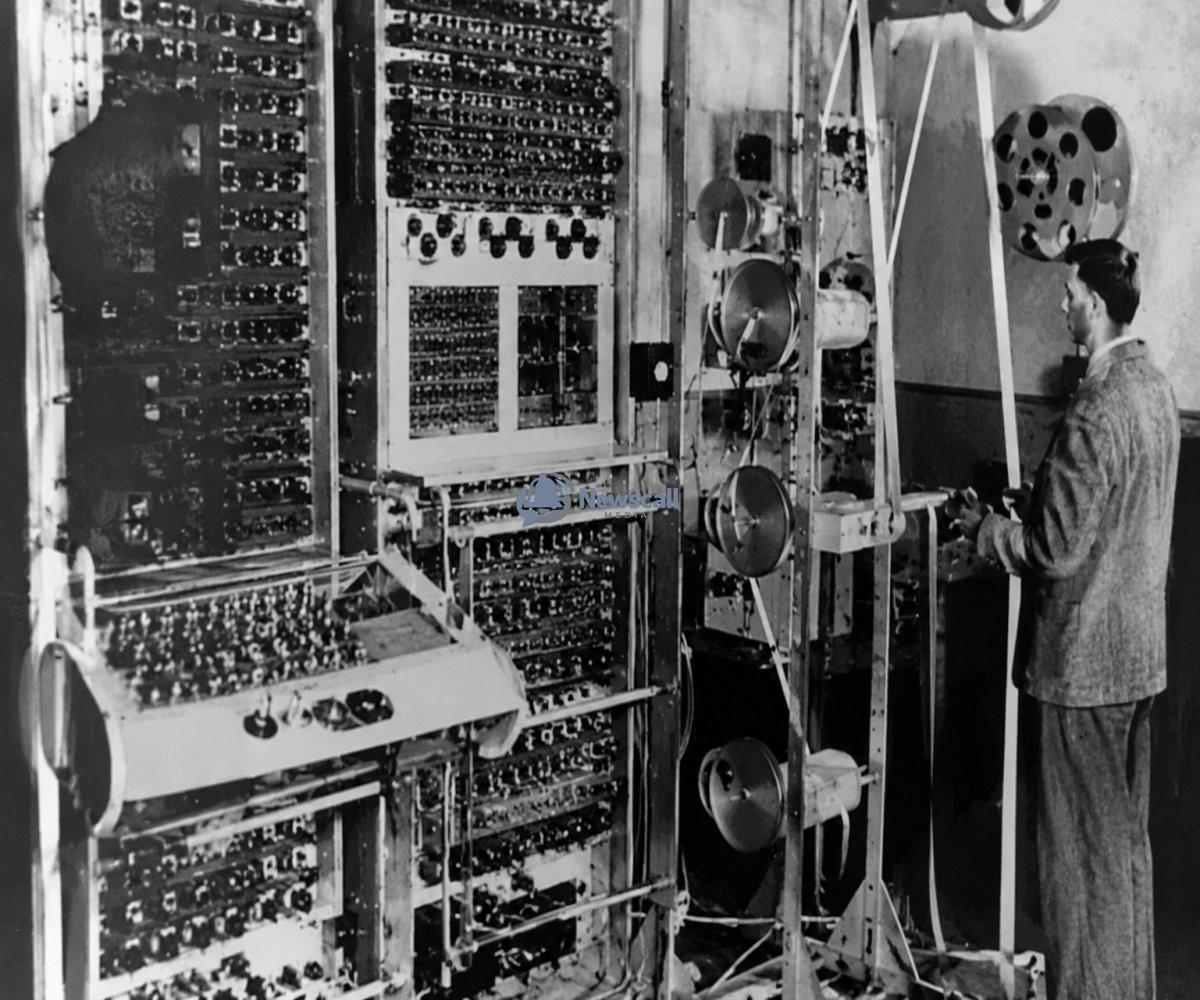
Colossus occupied an entire room.
Thousands of vacuum tubes glowed inside its panels.
Paper tapes carrying encrypted messages raced through the machine at remarkable speeds.
Electronic circuits analyzed patterns, performed calculations, and helped identify likely encryption settings.
For the first time in history, a machine was performing large-scale electronic data processing.
This was revolutionary.
Today, computers process billions of operations every second.
In the 1940s, even automating a fraction of that work was extraordinary.
Colossus dramatically accelerated the codebreaking process.
Messages that might have taken weeks to analyze could now be processed far more quickly.
The intelligence gathered from these decrypted communications proved enormously valuable.
Allied commanders gained insights into German military planning.
Strategic decisions became more informed.
Operations could be planned with better knowledge of enemy intentions.
Many historians believe that codebreaking efforts helped shorten the war by months or even years, potentially saving countless lives.
Yet the machine's influence extended far beyond the battlefield.
Colossus demonstrated something profound.
Electronic machines could process information faster than humans ever could.
They could analyze patterns.
They could automate calculations.
They could solve problems that previously seemed impossible.
In many ways, Colossus revealed the future.
After the war, however, almost nobody knew about it.
The British government classified the project as a state secret.
Most Colossus machines were dismantled.
Documents were destroyed.
People who worked on the project were forbidden from discussing it.
As a result, the machine's role remained hidden for decades.
Meanwhile, other early computers gained recognition and entered history books.
The contributions of Colossus remained largely invisible.
Only years later did historians begin uncovering the full story.
When the secrecy restrictions were eventually relaxed, the world learned that one of the earliest electronic computers had existed years before many people realized.
The revelation transformed our understanding of computing history.
Colossus wasn't a modern computer in the sense we think of today.
It couldn't run apps.
It couldn't browse websites.
It wasn't programmable in the same way modern machines are.
But it represented a crucial step toward the digital future.
Many ideas that define computing today—electronic processing, automation, high-speed calculation, and large-scale information analysis—were demonstrated by Colossus during the war.
Perhaps the most remarkable part of the story is how close the world came to forgetting it entirely.
Had the records remained secret forever, one of the most important technological achievements of the twentieth century might have disappeared from history.
Instead, Colossus is now recognized as a milestone in both computing and wartime innovation.
Its legacy lives on in every smartphone, laptop, server, and data center operating today.
Every email sent.
Every website visited.
Every search performed.
Every video streamed.
All are descendants of a technological journey that includes a room-sized machine built to crack secret wartime messages.
The machine was created to win a war.
But its greatest victory may have been showing humanity what computers could become.
And in doing so, it helped open the door to the digital world we now take for granted.

Victor Oluebubechukwu Akuma.
Creative writer