


The Future Is Being Built Underground, Underwater, and in Space
For a long time, progress had a familiar direction: outward, upward, visible. Cities rose into skylines, roads stretched across continents, and communication evolved from copper wires to satellites. Humanity built where it could be seen. Now that pattern is changing.
The next phase of human infrastructure is no longer defined by visibility. It is moving beneath oceans, disappearing under rock, and extending beyond Earth’s atmosphere. The most important systems being built today are the ones most people will never directly see.
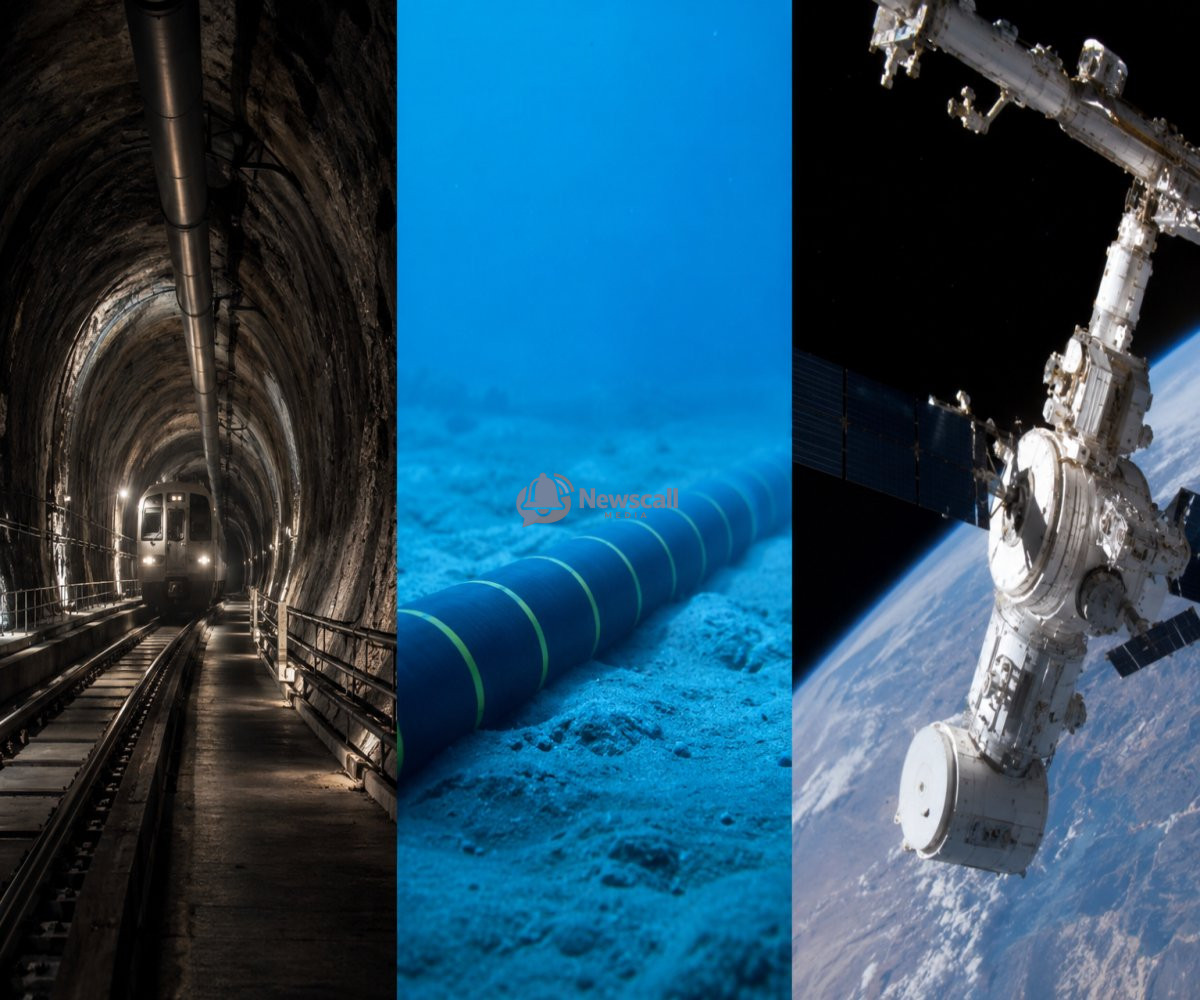
Under our feet, entire networks are being redesigned. Subsea data cables already carry more than 95% of global internet traffic, quietly connecting continents across the ocean floor. These cables form the hidden nervous system of modern civilization. But engineers are going further, experimenting with underwater data centers that use natural cooling to improve energy efficiency. At the same time, underground mining and infrastructure projects are expanding, not just for traditional resources but for the rare earth elements that power modern technology. As cities grow denser and surface conditions become more strained, the underground is becoming a practical frontier for industry, storage, and even urban expansion.
There are already early signs of underground urban systems in parts of the world, including transport tunnels, commercial spaces, and climate-controlled environments built below dense cities. What once felt like science fiction is increasingly becoming a response to real-world pressure: rising temperatures, land scarcity, and population growth. Building downward is no longer just about efficiency—it is about survival and long-term planning.
The ocean represents a different kind of frontier: scale. Offshore wind farms, floating energy platforms, and experimental sea-based infrastructure are expanding human activity into deep water environments. The ocean offers vast space and constant energy potential, but it also forces engineering to adapt to pressure, corrosion, and extreme weather. Despite these challenges, it is becoming clear that the ocean is not just a boundary. It is a usable platform for infrastructure, energy, and possibly even habitation systems in the future.
Above all of this lies space, the most extreme expansion layer. What was once purely exploratory is slowly becoming infrastructural. Private companies and space agencies are developing modular stations, testing orbital manufacturing, and planning long-term lunar operations. The International Space Station demonstrated that sustained human presence beyond Earth is possible. The next step is scalability: building systems that operate continuously in orbit, support research, and eventually extend resource and communication networks beyond Earth itself.
What connects underground, underwater, and space development is not geography but strategy. Each layer solves a different limitation. The underground offers stability and access to resources. The ocean provides space and energy potential. Space offers expansion and long-term continuity for civilization. Instead of spreading only across the surface, humanity is beginning to build in vertical layers across environments.
The most important structures of the next century may not be the tallest or the most visible. They may be the ones that operate quietly beneath oceans, deep under rock, or far above Earth. The future is not abandoning the surface. It is learning that the surface is only one layer of where civilization can exist.

Victor Oluebubechukwu Akuma.
Creative writer