

The Telescope Changing Everything We Know About Space
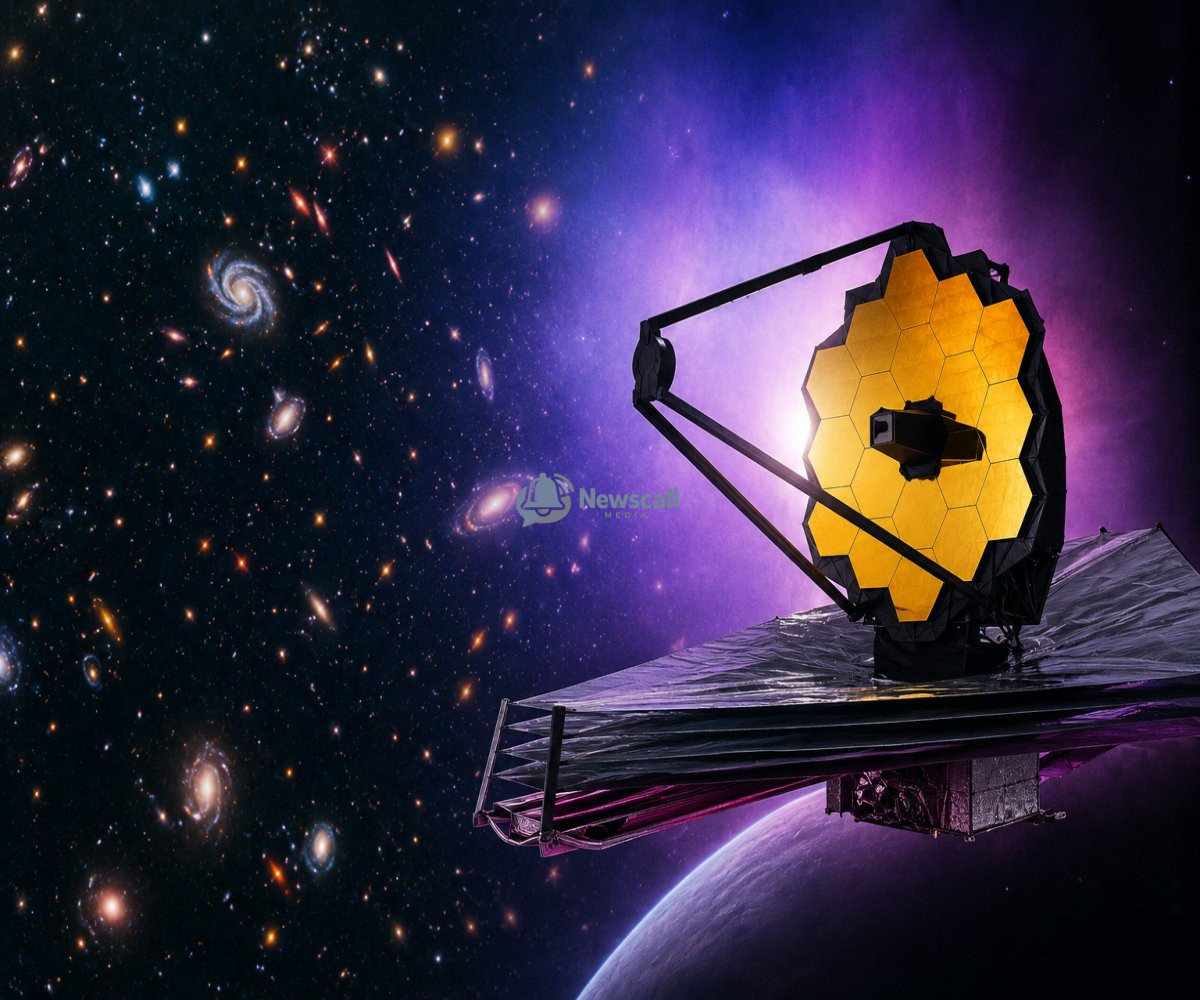
For decades, astronomy advanced in careful steps—each new telescope refining what we already believed we understood about the universe. But the arrival of the James Webb Space Telescope has disrupted that rhythm entirely. Instead of confirming expectations, it keeps challenging them.
We are no longer just observing space. We are reinterpreting it.
A New Window Into the Invisible Universe
Unlike earlier telescopes that relied heavily on visible light, the James Webb Space Telescope observes the universe primarily in infrared. This allows it to see through cosmic dust clouds and detect heat signatures from objects billions of light-years away.
What this means in practice is simple but profound: Webb is revealing parts of the universe that were previously hidden from human observation.
Galaxies that should not exist so early in cosmic history are appearing in its images. Planetary systems once thought to be rare are turning out to be far more common. Even the structure and behavior of distant galaxies are showing unexpected complexity.
Exoplanets Are No Longer Mysterious Blurs
One of the most exciting breakthroughs comes from the study of exoplanets—planets outside our solar system. Webb is not just detecting them; it is analyzing their atmospheres.
By reading the light that passes through or reflects off these distant worlds, scientists can identify chemical signatures such as water vapor, carbon dioxide, and methane.
This is the beginning of a shift from detecting planets to understanding their environments. It brings us closer to answering one of humanity’s oldest questions: Are we alone?
Black Holes and Cosmic Extremes Are Being Redefined
Webb is also transforming our understanding of black holes. Observations of early galaxies suggest that supermassive black holes may have formed faster and grown larger than current models can easily explain.
This challenges long-standing theories about how matter behaves under extreme gravitational conditions. Instead of filling gaps, the data is opening new ones.
In astronomy, that is usually a sign of progress.
When the Universe Refuses to Behave
Perhaps the most striking outcome of Webb’s observations is not a single discovery, but a pattern: the universe appears more complex, more active, and more “mature” than expected at early stages.
That forces scientists to reconsider foundational assumptions about how quickly structures formed after the Big Bang.
In other words, the universe is not just being observed more clearly—it may be fundamentally different from what earlier models predicted.
A Turning Point in Human Perspective
The James Webb Space Telescope is not just improving astronomy. It is reshaping it.
Every dataset it sends back is forcing scientists to refine, rethink, or sometimes abandon established ideas. And as more observations come in, the boundary between known and unknown continues to shift.
We are living in a moment where the universe is still being rewritten in real time.
And the telescope doing it is only just getting started.

Victor Oluebubechukwu Akuma.
Creative writer