

15 Engineering Breakthroughs Inspired by Animals
Innovation doesn't always begin in a laboratory.
Sometimes, it begins in a forest, an ocean, or even a backyard.
For millions of years, animals have been solving problems related to movement, survival, efficiency, and adaptation. As engineers studied these natural solutions, they discovered something remarkable: many of nature's designs outperform human inventions.
This has led to some of the most fascinating engineering breakthroughs in history.
1. Velcro — Inspired by Burrs
In 1941, Swiss engineer George de Mestral noticed burrs sticking stubbornly to his clothes and his dog's fur. Under a microscope, he discovered tiny hooks that latched onto loops in fabric. This simple observation led to the invention of Velcro, now used in everything from shoes to space suits.
2. Bullet Trains — Inspired by Kingfishers
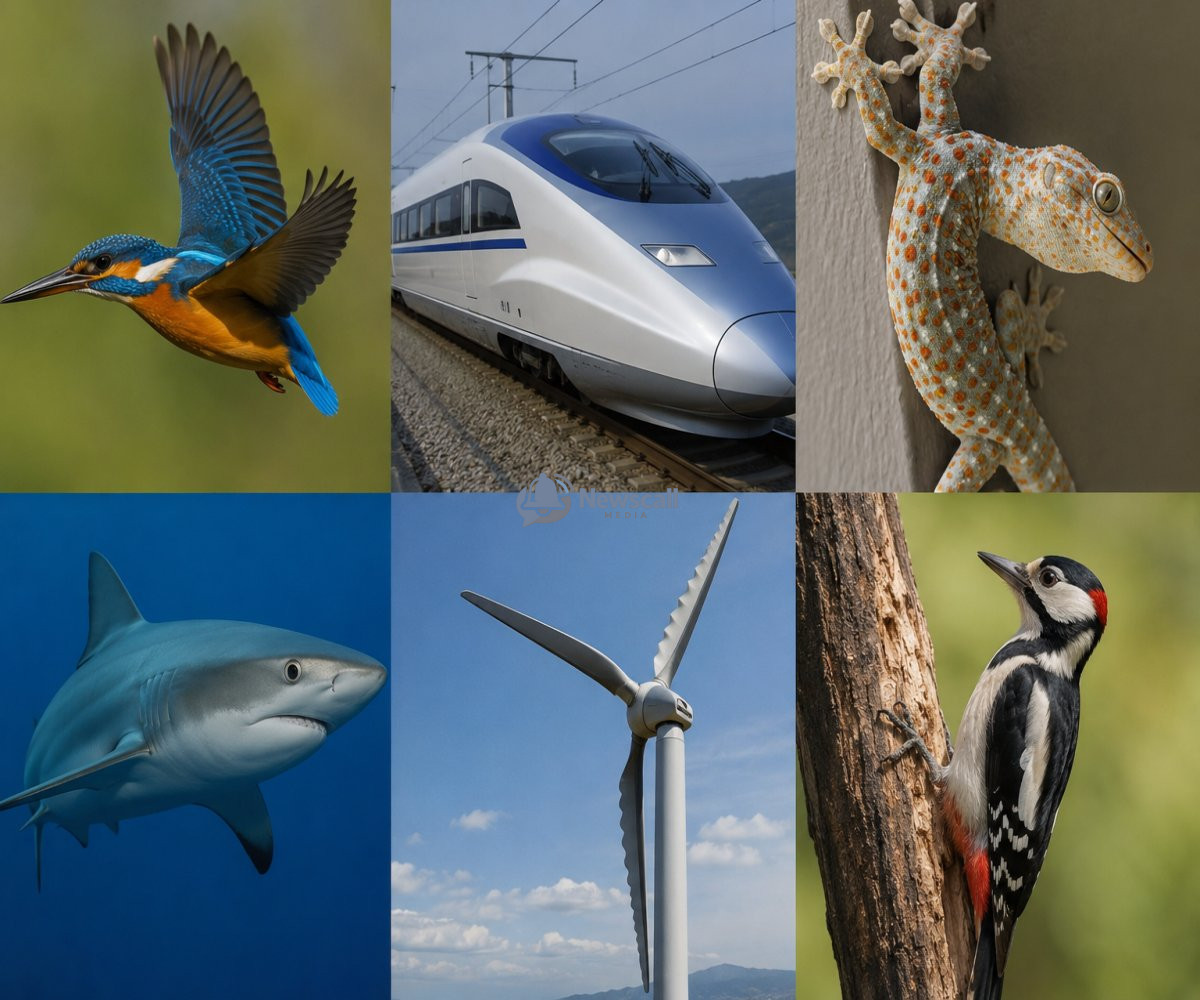
Japan's early high-speed trains produced loud sonic booms when exiting tunnels. Engineers found inspiration in the kingfisher, a bird that dives into water with almost no splash. A redesigned train nose modeled after the bird's beak reduced noise while improving speed and efficiency.
3. Sonar Systems — Inspired by Bats
Bats navigate and hunt in complete darkness using echolocation. By emitting sound waves and analyzing the returning echoes, they can detect obstacles and prey. This principle inspired modern sonar and navigation systems.
4. Aircraft Wing Designs — Inspired by Eagles
The shape and structure of eagle wings have influenced aircraft engineering for decades. Their aerodynamic design helps reduce drag and improve lift, making flight more efficient.
5. Anti-Bacterial Surfaces — Inspired by Shark Skin
Shark skin contains microscopic patterns that prevent bacteria and parasites from attaching easily. Engineers have replicated these patterns to create cleaner surfaces in hospitals and public facilities.
6. Super Adhesives — Inspired by Geckos
Geckos can walk across walls and ceilings thanks to millions of tiny hair-like structures on their feet. Scientists have used this concept to develop powerful adhesives that leave no residue behind.
7. Ultra-Strong Materials — Inspired by Spider Silk
Spider silk is stronger than steel by weight while remaining incredibly flexible. Researchers continue studying it to develop lightweight materials for construction, medicine, and protective equipment.
8. Energy-Efficient Buildings — Inspired by Termites
Termite mounds maintain stable temperatures despite extreme outdoor conditions. Architects have copied this natural ventilation system to design buildings that require less energy for heating and cooling.
9. More Efficient Wind Turbines — Inspired by Humpback Whales
The bumps on humpback whale fins improve maneuverability in water. Engineers applied similar designs to wind turbine blades, increasing efficiency and performance.
10. Silent Aircraft Technology — Inspired by Owls
Owls can fly almost silently thanks to the unique structure of their feathers. Aerospace engineers study these features to reduce aircraft noise and improve stealth technology.
11. Advanced Imaging Systems — Inspired by Lobsters
Lobsters have unusual eye structures that can detect light differently from human eyes. These designs have inspired imaging technologies used in medicine and security systems.
12. Agile Drones — Inspired by Hummingbirds
Hummingbirds can hover, fly backward, and make rapid directional changes. Engineers use these flight mechanics to design highly maneuverable drones.
13. Shock Absorption Technology — Inspired by Woodpeckers
Woodpeckers repeatedly strike trees at high speeds without suffering brain injuries. Studying their skull structure has helped engineers develop improved helmets and protective equipment.
14. Soft Robotics — Inspired by Octopuses
Unlike traditional robots, octopuses move with extraordinary flexibility. Their unique anatomy has inspired soft robotic systems capable of navigating delicate environments.
15. Underwater Vehicles — Inspired by Penguins
Penguins are exceptionally efficient swimmers. Their movement patterns have influenced the design of underwater vehicles used for research and exploration.
Nature remains one of humanity's greatest engineering teachers.
Long before humans built airplanes, robots, or high-speed transportation systems, animals had already evolved solutions to many of the same challenges. By observing and learning from the natural world, engineers continue to create innovations that are smarter, more efficient, and more sustainable.
The next breakthrough may not come from a laboratory.
It may already be walking, swimming, or flying somewhere in nature.

Victor Oluebubechukwu Akuma.
Creative writer