


How Dead Satellites Find Their Way Back To Earth
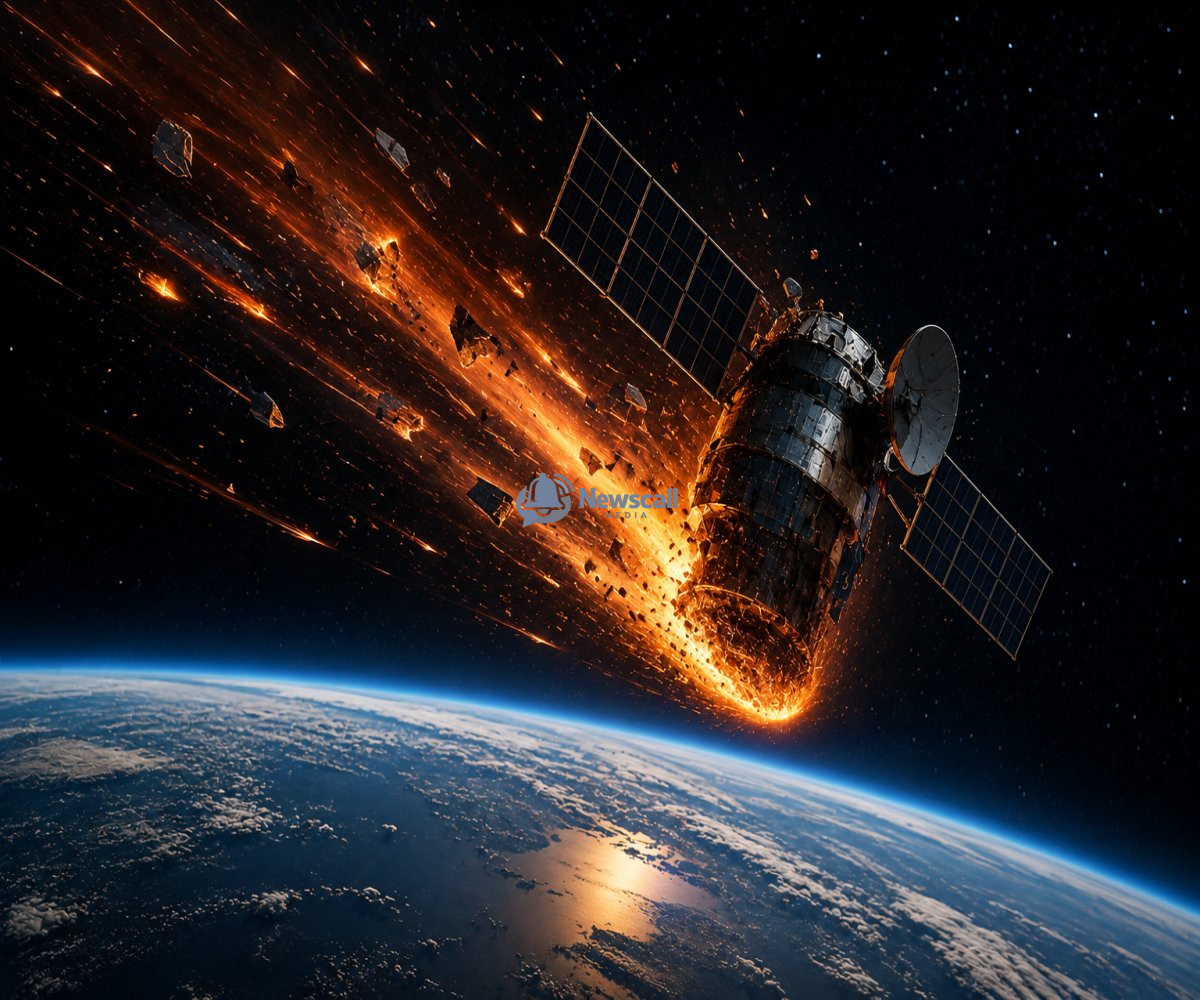
When a satellite reaches the end of its life, many people imagine it simply dropping from space like a rock falling from the sky.
Reality is far stranger.
Satellites don't suddenly lose their grip on Earth.
They don't switch off and plunge straight down.
Instead, they begin one of the slowest and most dramatic falls in the universe.
Some spend years descending.
Others burn up completely before anyone on the ground even notices.
Every satellite launched into orbit is constantly falling.
That might sound impossible.
If they're falling, why don't they hit Earth?
The answer lies in speed.
A satellite travels sideways at around 28,000 kilometers per hour while Earth's gravity pulls it downward at the same time.
Because the planet curves away beneath it, the satellite keeps missing the ground.
It remains in a continuous state of free fall.
That's what orbit really is.
But no orbit lasts forever.
Even hundreds of kilometers above Earth, space isn't completely empty.
There are still tiny traces of our planet's atmosphere.
Individually, those air molecules are insignificant.
Over months and years, they become a powerful braking force.
Each collision steals an almost immeasurable amount of speed from the satellite.
Eventually, those tiny losses begin to add up.
As the satellite slows down, its orbit becomes lower.
A lower orbit contains more atmosphere.
More atmosphere creates more drag.
More drag slows the satellite even further.
The process feeds itself.
The satellite begins spiraling toward Earth.
This stage is known as orbital decay.
What happens next depends on the satellite.
Most spacecraft never reach the ground.
As they plunge into the thicker layers of Earth's atmosphere, air resistance increases dramatically.
The friction generates extraordinary heat.
Temperatures can climb beyond 1,600 degrees Celsius, hot enough to melt aluminum and many other metals.
Contrary to popular belief, satellites don't burn because the air itself is hot.
They burn because they're moving so fast that the air in front of them becomes violently compressed.
That compression produces intense heat capable of tearing spacecraft apart.
Panels break away.
Fuel tanks rupture.
Solar arrays disintegrate.
Large satellites often fragment into hundreds of glowing pieces, creating brilliant streaks across the night sky.
From the ground, it can resemble an unusually slow meteor shower.
Most of the debris never survives.
It vaporizes long before reaching Earth's surface.
Engineers actually design many satellites with this outcome in mind.
Using lightweight materials that melt easily reduces the chances of dangerous debris reaching populated areas.
Some satellites, however, are simply too large to disappear completely.
Space stations and massive spacecraft contain components made from titanium, stainless steel, and other heat-resistant materials.
These parts can survive re-entry.
Rather than leaving their final destination to chance, space agencies carefully control their descent.
Using onboard engines, they guide the spacecraft toward remote regions of the ocean, far from shipping routes and populated coastlines.
One area in particular has become famous for this purpose.
Located in the South Pacific Ocean, far from major landmasses, it has earned the nickname the spacecraft cemetery.
Over the years, hundreds of retired spacecraft have ended their journeys there.
Not every satellite waits for nature to decide its fate.
Many modern spacecraft carry enough fuel to perform a controlled deorbit.
When their missions end, operators fire the engines one final time, deliberately lowering the orbit until atmospheric drag takes over.
This allows engineers to predict where any surviving debris will land.
It's a safer and more responsible way to manage the growing number of objects orbiting Earth.
The challenge is becoming more important every year.
Thousands of active satellites now circle the planet, and tens of thousands more are expected to launch over the coming decade.
Without careful planning, old satellites could remain in orbit for decades, increasing the risk of collisions and creating dangerous clouds of space debris.
That's why engineers now think about the end of a satellite's life before it's even launched.
Some spacecraft are designed to burn up completely.
Others carry propulsion systems dedicated solely to their final descent.
Future concepts even include robotic spacecraft capable of capturing dead satellites and guiding them safely back to Earth.
In space, every mission eventually comes to an end.
But the final chapter isn't a dramatic plunge from the heavens.
It's a slow, invisible spiral.
A gradual surrender to gravity.
And for most satellites, the last thing they ever become isn't a machine orbiting Earth.
It's a brief streak of light disappearing

Victor Oluebubechukwu Akuma.
Creative writer