

Inside the Race to Keep Human Organs Alive Outside the Body
The moment a donated organ leaves the human body, a countdown begins.
The heart no longer receives blood.
The lungs stop exchanging oxygen.
Cells begin consuming the little oxygen they have left.
Every passing minute brings the organ closer to becoming unusable.
For decades, doctors have fought that countdown in the simplest way possible.
Ice.
Cooling an organ slows its metabolism, reducing how quickly its cells consume oxygen and nutrients. It buys surgeons valuable time to transport the organ from a donor to a recipient.
But ice has always had one major limitation.
It doesn't keep an organ alive.
It only slows the process of dying.
That means every transplant is a race against the clock.
A donated heart typically remains viable for only four to six hours.
Lungs last only slightly longer.
Even the liver, one of the most durable transplant organs, has a limited window before its condition begins to decline.
Once that time runs out, the chances of a successful transplant drop dramatically.
Scientists have spent years asking a remarkable question.
What if an organ didn't have to slowly deteriorate while waiting for surgery?
What if it could continue living outside the human body?
That idea has given rise to one of the most exciting breakthroughs in modern medicine.
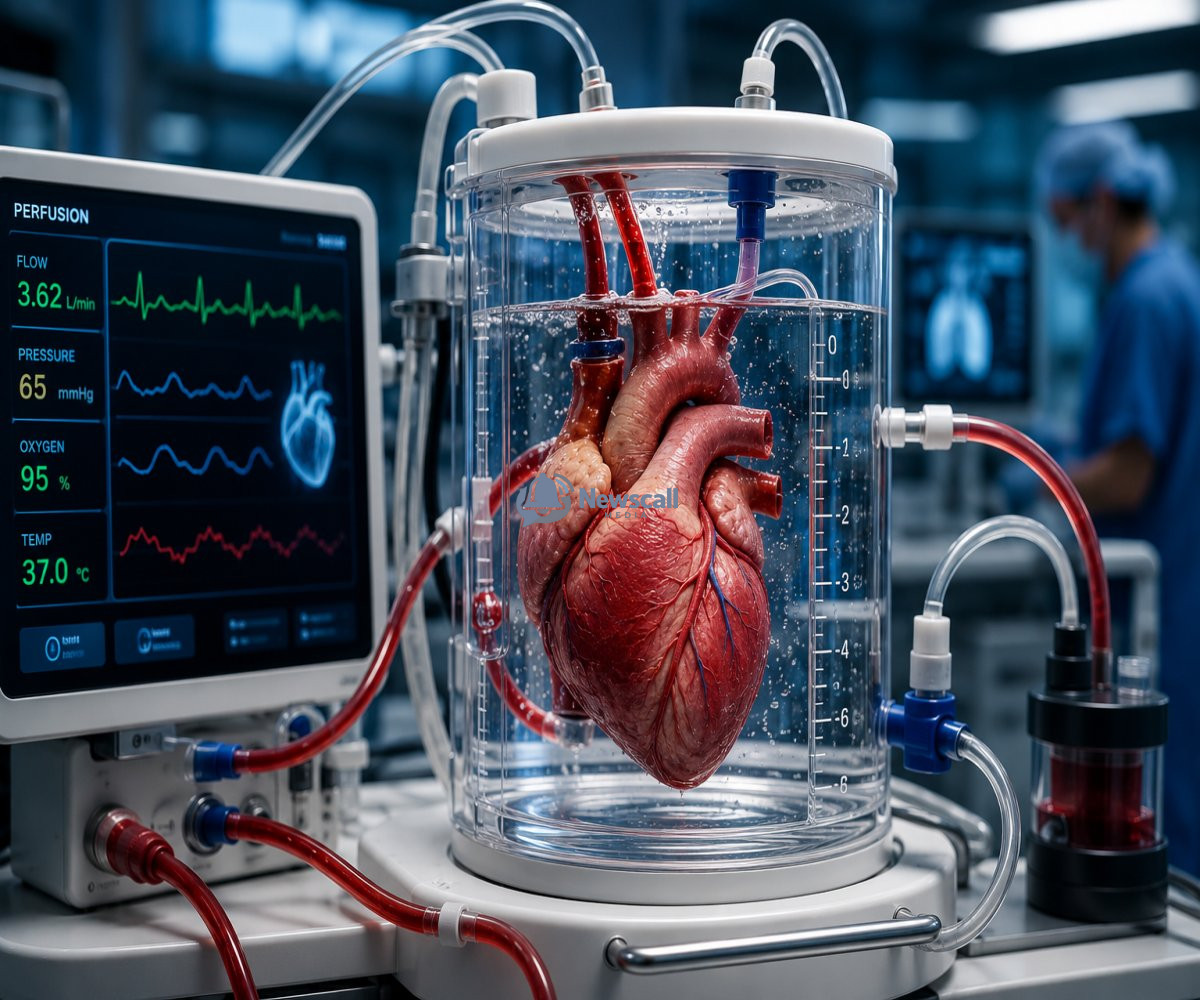
Instead of placing organs in containers filled with ice, researchers are increasingly using machines that recreate many of the conditions found inside the body.
The technology is known as machine perfusion.
Rather than allowing an organ to remain dormant, the machine continuously pumps oxygen-rich blood or specially formulated nutrient solutions through its blood vessels.
The organ doesn't simply sit there.
It continues functioning.
A donated heart can keep beating.
Lungs can continue expanding and exchanging gases.
A liver can continue processing nutrients and producing bile.
It's one of the closest things medicine has to temporarily placing an organ inside an artificial body.
The advantages go far beyond extending preservation time.
For the first time, doctors can observe how an organ performs before it is transplanted.
They can monitor blood flow.
Measure oxygen consumption.
Assess how well the tissue is functioning.
If problems appear, they may even be able to treat the organ while it remains connected to the machine.
Researchers are already testing ways to deliver medications directly into preserved organs, reduce inflammation, repair damaged tissue, and improve organs that would once have been considered unsuitable for transplantation.
Some donated organs that previously would have been discarded could soon become lifesaving transplants.
That matters because organ shortages remain one of medicine's greatest challenges.
Across the world, thousands of patients die every year while waiting for a suitable donor.
Increasing the number of usable organs—even by a small percentage—could save countless lives.
The technology could also transform how far organs can travel.
Today, many donor organs must remain relatively close to the recipient because preservation time is so limited.
Keeping organs alive for longer would allow doctors to transport them across much greater distances, increasing the chances of finding the best possible match for every patient.
Behind the scenes, the engineering is extraordinarily complex.
The machines must carefully regulate temperature, pressure, oxygen levels, nutrient delivery, and circulation.
Even slight imbalances can damage delicate tissues.
In many ways, these systems function as temporary life-support machines—not for people, but for individual organs.
And scientists aren't stopping there.
Researchers are now exploring whether organs could eventually be repaired, genetically modified, or even rejuvenated while outside the body.
Instead of simply preserving an organ, future machines may improve it before transplantation.
What once sounded like science fiction is steadily becoming reality.
The future of transplantation may no longer depend solely on finding the right donor.
It may also depend on what happens between donation and surgery.
Keeping a human organ alive outside the body was once considered impossible.
Today, it's becoming one of the most promising frontiers in medical innovation.
Sometimes, saving a life isn't about performing a better operation.
It's about giving an organ enough time to reach the person who needs it most.

Victor Oluebubechukwu Akuma.
Creative writer