

The Secret She Carried
A Story About Hyperhidrosis — and the Millions Who Have Never Told It
A medically sensitive guide to excessive sweating — its causes, impact, and what you can do about it
“I wore black every single day for eleven years. Not because I liked it. Because I was terrified of what people would see.”
Her name is Amara. She is 29, a secondary school teacher, and by most accounts, composed and confident in everything she does. But for over a decade, she carried a secret that shaped every outfit she chose, every handshake she considered, every classroom she stood in front of with her arms pressed carefully to her sides.
She did not have a hygiene problem. She did not have anxiety — at least, not to begin with. What Amara had was hyperhidrosis. And like more than 365 million people around the world, she had never heard the word that described what she was living with.
This is her story. And in many ways, it might be yours too.
What Is Hyperhidrosis?
Hyperhidrosis is sweating the body produces beyond any physiological need — regardless of temperature, exertion, or emotion. It is a real, diagnosable condition with a name that most sufferers go years without hearing. It comes in two forms:
• Primary Hyperhidrosis — Has no underlying medical cause. It tends to concentrate in specific areas — palms, feet, underarms — and often begins in childhood or adolescence. It has a strong genetic component; if a parent has it, the odds of a child developing it are significantly elevated.
• Secondary Hyperhidrosis — Is triggered by an underlying condition or medication, can affect the whole body, and can develop at any age. This form demands medical evaluation because the sweating is a symptom, not the root problem.
~5% of people worldwide. Approximately 365 million people are estimated to have hyperhidrosis globally — yet many will go years without a diagnosis. (International Hyperhidrosis Society)
Where It Strikes — and Why It Matters
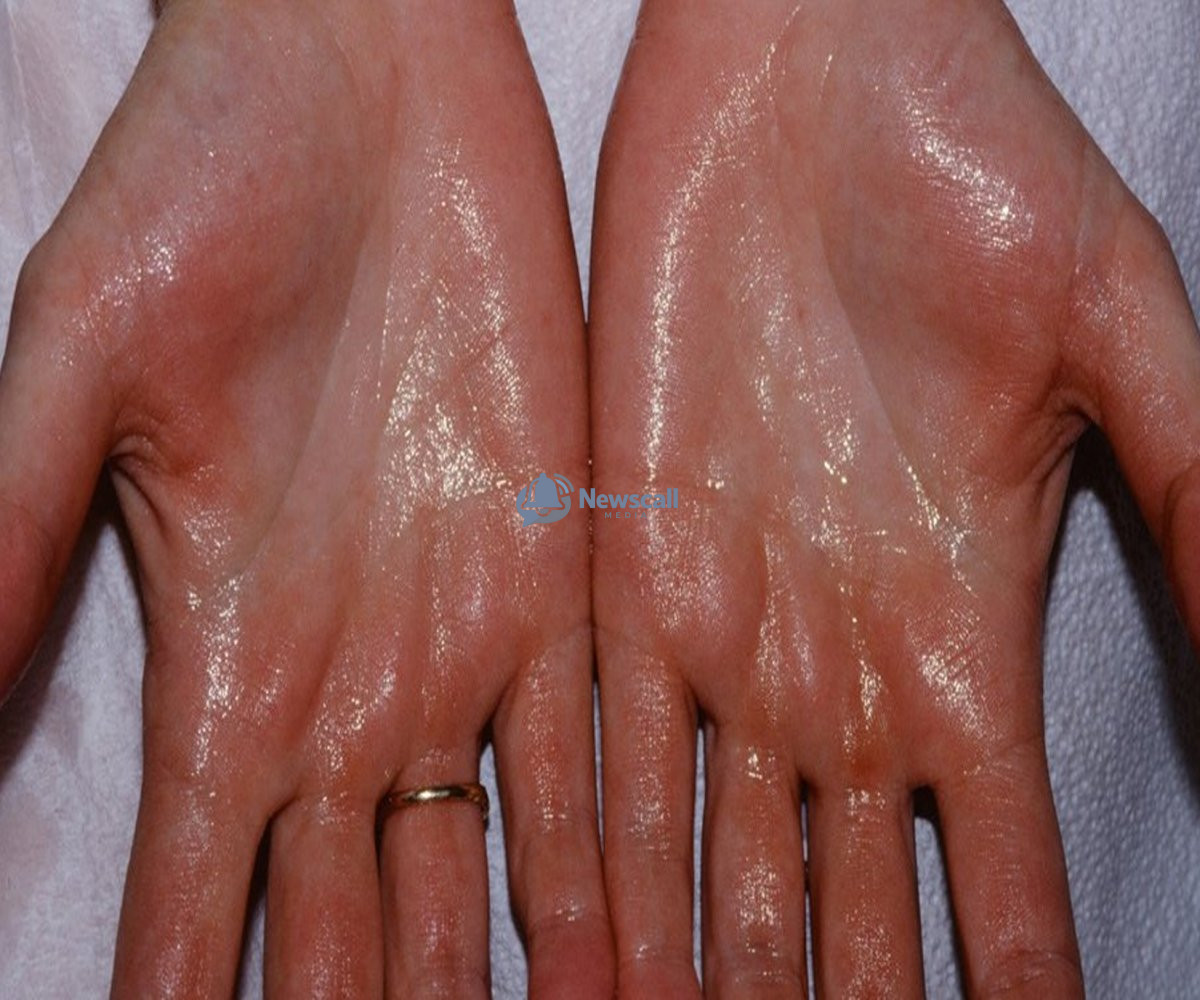
Hyperhidrosis does not follow a single pattern. For some people it is the palms — making handshakes feel like a confession, turning paper documents into a damp mess, making phone calls leave a literal mark on the screen. For others, it is the soles of the feet, soaking through socks and shoes, creating conditions for fungal infections and chronic discomfort. For still others, it is the underarms or the face — the most visible, most social, most impossible-to-hide areas.
• Palms — palmar hyperhidrosis is one of the most socially disruptive forms; sufferers often avoid physical contact, struggle with writing and driving, and report significant occupational challenges
• Soles of the feet — plantar hyperhidrosis creates persistent discomfort, increased odor, and a higher susceptibility to skin infections
• Underarms — axillary hyperhidrosis is the form most associated with visible staining, clothing choices, and social self-consciousness
• Face and scalp — craniofacial hyperhidrosis is the rarest and often the most emotionally distressing; it is virtually impossible to conceal
One important clinical distinction: in primary hyperhidrosis, sweating typically stops during sleep. In secondary hyperhidrosis, it may not — and night sweats can themselves be a significant warning sign of underlying illness.
30–50% familial cases. Between 30 and 50 percent of hyperhidrosis cases are thought to have a genetic basis — meaning if someone in your family has it, your risk is meaningfully elevated. (American Academy of Dermatology)
“I used to plan my entire day around sweat. Which meetings I could avoid. Which handshakes I could redirect. It is exhausting when your brain has to work that hard just to seem normal.”
What Is Actually Happening in the Body?
In primary hyperhidrosis, the autonomic nervous system — specifically the sympathetic branch responsible for the “fight or flight” response — is essentially overactive. Sweat glands receive signals to produce sweat even when there is no thermal or emotional justification for it. It is a miscommunication at the neurological level, not a failure of willpower or personal care.
Secondary hyperhidrosis has identifiable triggers. The most common include:
• Hormonal changes — including puberty, pregnancy, perimenopause, and menopause
• Infections — tuberculosis and HIV/AIDS are among the most documented infectious causes
• Metabolic conditions — diabetes and recurrent hypoglycemia (low blood sugar)
• Thyroid dysfunction — particularly hyperthyroidism, which accelerates the body’s metabolic rate
• Medications — certain antidepressants, antihypertensives, and pain medications list excessive sweating as a known side effect
• Neurological conditions — Parkinson’s disease and spinal cord injuries can disrupt autonomic function
• Malignancy — some cancers, including lymphoma, are associated with generalized sweating and night sweats
The clinical takeaway: if sweating begins suddenly, worsens progressively, involves the whole body, or consistently disturbs sleep, it should be medically evaluated. In these cases, the sweat is not the problem — it is the messenger.
1 in 3 affected workers. One in three people with hyperhidrosis reports that the condition has influenced their career decisions or professional performance — from avoiding certain job roles to declining promotions that require more social contact. (International Hyperhidrosis Society)
More Than Sweat: The Emotional Weight
There is a version of this story that stays skin-deep. Sweaty palms. Wet shirts. An inconvenience. But for the people who live it, hyperhidrosis reaches far beneath the surface.
Amara remembers the exact moment she decided not to become a surgeon. She had always loved medicine. She was academically equipped for it. But the thought of operating — of hands that could not be trusted to stay dry — closed that door before she ever approached it. She chose teaching instead. She loves it. But the choice was never entirely hers.
• Confidence and self-image — chronic shame and hypervigilance about appearance are common
• Social relationships — many sufferers avoid physical contact, social gatherings, dating, and public speaking
• Professional opportunities — career choices are shaped, constrained, and sometimes abandoned because of hyperhidrosis
• Daily functioning — writing, typing, cooking, holding objects, using devices — tasks that require dry hands become effortful
• Mental health — documented rates of anxiety and clinical depression are significantly elevated in this population
For some, the condition begins quietly in adolescence — a damp handshake here, a soaked collar there — and then slowly, without announcement, it begins to shape a life.
One patient, who developed excessively sweaty palms and feet from a young age, described a life quietly reorganised around the condition. Handshakes were avoided. Certain shoes were off-limits. As the sweating became more widespread over the years, choices that others make instinctively — what colour to wear, what fabric to buy, whether to reach out and touch someone — became small, daily negotiations with anxiety. By any external measure, he was professionally successful, physically healthy, and surrounded by people who cared about him. And yet an episode of excessive sweating could still, in an instant, make him feel smaller than the room. He described how concerns about rejection had quietly threaded their way into how he approached dating and intimacy — not dramatically, not with declarations, but in the slow accumulation of hesitations. Hyperhidrosis had not broken his confidence. It had simply been borrowing from it, steadily, for years.
What rarely gets acknowledged is the invisible architecture most sufferers build around their condition — always wearing dark clothing, keeping spare garments close, arriving early to settle before the sweating starts, steering conversations away from anything physical. These adaptations can be impressively effective. They can also be exhausting to maintain, and over time quietly reinforce the belief that something about you must be concealed.
Studies have placed the quality-of-life impairment from hyperhidrosis on par with conditions like severe psoriasis and chronic eczema. Yet psoriasis has awareness campaigns. Eczema has charity walks. Hyperhidrosis has mostly silence.
75% of patients; Three in four people with hyperhidrosis report that the condition negatively affects their emotional or psychological wellbeing. Rates of depression and social anxiety disorder are substantially higher in this group than in the general population. (Dermatologic Surgery Journal)
“The hardest part was never the sweat itself. It was the shame I built around it. The belief that it was somehow my fault.”
That shame has a cost. It keeps people from raising their hand in class, from accepting a first date, from shaking the hand of a new employer. It keeps them from walking into a doctor’s office and saying the words out loud.
It kept Amara silent for eleven years.
When to Seek Help — and What to Expect
The single most important barrier to treatment for hyperhidrosis is not access to healthcare. It is the belief that nothing can be done — or that the condition is too embarrassing to bring up.
• Sweating is excessive, persistent, and disproportionate to the situation
• It is actively interfering with work, school, relationships, or daily tasks
• It occurs during sleep — particularly if this is new or worsening
• It has developed suddenly or has been steadily escalating
• It is causing significant emotional distress, avoidance behaviour, or social withdrawal
A good diagnostic evaluation involves more than a quick glance. Your doctor will take a detailed medical history, examine the affected areas, and — if secondary hyperhidrosis is suspected — may order investigations such as blood glucose measurements, thyroid function tests, or further imaging depending on the clinical picture.
When speaking with your doctor, try to be specific:
• How long have you been experiencing excessive sweating?
• Which areas are affected, and does it happen symmetrically (both hands, both underarms)?
• Does it occur at night, or only when you are awake?
• Has anything changed recently — medications, health conditions, significant stress, hormonal changes?
• How does it affect your day-to-day life and emotional wellbeing?
Do not minimise your experience to seem less bothersome. The more precisely you describe it, the better equipped your doctor is to help.
< 40% seek care. Fewer than four in ten people with hyperhidrosis ever discuss it with a physician — despite the fact that effective, evidence-based treatments are available. (International Hyperhidrosis Society)
She finally said it out loud at 27. Two words to her GP: ‘excessive sweating.’ What followed was the most straightforward medical conversation she had ever had.
Yes, It Can Be Managed
When Amara finally described her symptoms to a doctor, she expected to be dismissed. Instead, she left with a treatment plan and a referral to a dermatologist. Within three months, her symptoms had reduced by more than half.
• Clinical-strength antiperspirants — containing aluminum chloride; often the first line of treatment and effective for many with mild to moderate axillary or palmar hyperhidrosis
• Topical therapies — newer glycopyrronium-containing formulations are now approved for certain forms of hyperhidrosis and have strong efficacy data
• Oral medications — anticholinergic agents reduce overall sweat production; must be balanced against potential side effects
• Iontophoresis — a non-invasive device treatment that passes mild electrical currents through water to temporarily reduce sweating of the hands and feet; requires regular sessions but has a strong safety profile
• Botulinum toxin injections (Botox) — highly effective for axillary hyperhidrosis; results typically last 6 to 12 months and the procedure is increasingly available through dermatology services
• Microwave thermolysis (miraDry) — a procedure that permanently reduces underarm sweat glands using microwave energy; suitable for those with severe axillary hyperhidrosis
• Endoscopic thoracic sympathectomy (ETS) — a surgical option reserved for severe, treatment-resistant cases; involves interrupting the sympathetic nerve signals that trigger sweating
• Lifestyle measures — breathable fabrics, moisture-wicking garments, awareness of dietary triggers (spicy foods, caffeine), and stress management strategies all play a supporting role
82–87% success rate. Between 82 and 87 percent of patients treated with Botox injections for axillary hyperhidrosis report at least a 50 percent reduction in sweating — making it one of the most effective interventions available. (Journal of the American Academy of Dermatology)
A Note on Medical Sensitivity
Hyperhidrosis occupies an uncomfortable space in the public imagination. Because sweat is associated with poor hygiene — unfairly, in this context — people who suffer from it often internalise the stigma. They arrive at the doctor already apologising for what they are about to say.
You do not need to apologise. Hyperhidrosis is a legitimate, well-documented medical condition. It is not caused by insufficient showering. It is not a reflection of character or willpower. It is a physiological dysregulation with clinical solutions.
If the emotional impact of hyperhidrosis has been significant — if it has contributed to anxiety, depression, avoidance behaviours, or a diminished sense of self — say so. The psychological dimension of this condition is as real as the physical one, and addressing it may be equally important to your recovery.
Some patients benefit from a combination of dermatological treatment and psychological support, particularly if years of shame have compounded the condition’s effects on self-image and social functioning.
Seeking help is not a dramatic step. It is a quiet, practical one — and it is available to you.
The End of the Secret
Amara wears colour now. Not every day — old habits are slow to leave — but more often. She shakes hands without rehearsing it. She raises her arm to write on the whiteboard without thinking.
She still has hyperhidrosis. Treatment does not always mean elimination. But it meant control. It meant that the condition no longer controlled her.
If any part of this story felt familiar — the planning, the covering up, the exhausting mental arithmetic of navigating a world that does not know what you are managing — then this is your reminder that there is a name for what you are experiencing.
There is a consultation room where you can say it out loud. There is a doctor who will not be surprised. There is a treatment plan that may change your daily life in ways you have stopped allowing yourself to imagine.
Excessive sweating is not something you have to carry alone. Understanding it is the first step. Seeking help is the second. And neither one is as hard as the years of silence that came before.
References
International Hyperhidrosis Society (IHhS) | American Academy of Dermatology (AAD) | Journal of the American Academy of Dermatology (JAAD) | Dermatologic Surgery Journal

Abiodun Oluwafemi
Copywriting, brandnaming, research.