

The Chip That Creates Its Own Encryption Keys
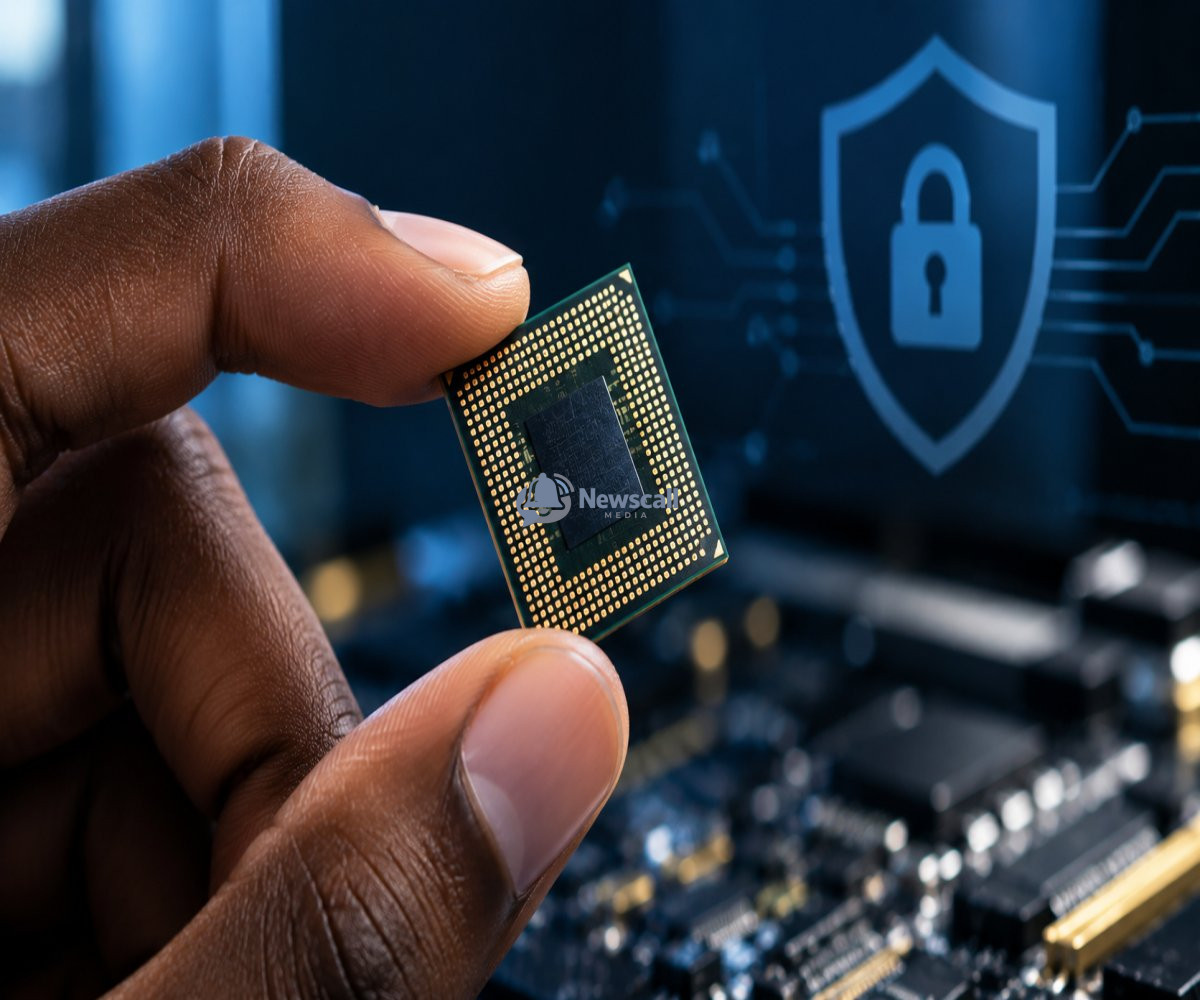
Every computer chip looks almost identical to another chip of the same model.
But at microscopic levels, no two chips are perfectly the same.
Tiny variations introduced during semiconductor manufacturing give each piece of silicon its own physical characteristics. Those differences are normally treated as imperfections. Fortaegis, a Dutch deep-tech company, is turning them into something much more valuable: a foundation for digital security.
The company has just raised $50 million in an oversubscribed Series A round to accelerate the commercial production of its Secure Compute technology, a hardware-and-software architecture designed to build security directly into silicon rather than treating it as another layer added afterward. The round was led by Serendipity Capital, with participation from Tokyo Electron's venture arm, TNO, Prodrive Technologies and other investors.
The idea sounds almost strange at first.
Instead of storing a secret encryption key somewhere inside a device and hoping attackers never get access to it, Fortaegis wants the physical chip itself to become part of the secret.
This is possible because semiconductor manufacturing inevitably creates tiny variations between individual chips. Even chips produced from the same design will have physical characteristics that cannot be perfectly reproduced. Security systems known as physically unclonable functions, or PUFs, can use these characteristics to produce a distinctive digital response from a particular piece of hardware.
Think of it like a fingerprint.
Two people may have the same basic anatomy, but their fingerprints are different. In much the same way, two chips can be manufactured from the same blueprint while possessing microscopic physical differences.
A conventional digital key can be copied.
A physical characteristic embedded in the silicon is much harder to reproduce.
Fortaegis is building its architecture around that principle.
Its Silicon Platform combines hardware, firmware, cryptography and software, with the company's technology using the physical properties of silicon to establish identity and trust across connected computing systems. The company says this approach allows security to extend from the chip through the rest of the computing stack.
Why does that matter now?
Because computers are no longer operating in isolation.
AI is creating enormous networks of machines that communicate with one another. Data centres contain thousands of processors. Autonomous vehicles need to exchange information with other systems. Industrial robots increasingly operate without continuous human supervision. Drones can coordinate with one another. Edge devices can make decisions locally and send information across networks.
The number of machines that need to prove who they are is therefore exploding.
And traditional security systems were not necessarily designed for a world containing billions of autonomous devices communicating at machine speed.
Fortaegis believes security needs to move closer to the physical foundation of computing.
That is where its approach becomes particularly interesting.
Imagine a fleet of autonomous drones operating together. Each drone needs to know that the other machines in the network are legitimate. If an attacker manages to insert a counterfeit device into the network, the consequences could be serious.
A hardware-rooted identity gives each system a physical basis for proving that it is the device it claims to be.
The same concept could apply to AI infrastructure.
Large AI systems increasingly depend on enormous networks of processors moving sensitive models, data and inference results between machines. If security mechanisms add too much overhead, they can become a bottleneck.
Fortaegis says its internal and customer testing has demonstrated connection performance more than 200 times faster than conventional approaches while maintaining its hardware-rooted security architecture. That figure is a company-reported result rather than an independently established industry benchmark, but it illustrates the performance advantage Fortaegis is pursuing.
The company is also positioning the technology around another looming problem: quantum computing.
Today's internet relies heavily on cryptographic systems that could eventually be threatened by sufficiently powerful quantum computers. That does not mean current encryption suddenly becomes useless when the first large quantum computer appears, but it does mean organizations are increasingly preparing for cryptography that can withstand future quantum attacks.
Fortaegis describes its architecture as quantum-safe by design and says it is intended to provide a foundation for secure computing in the quantum era.
There is another important distinction, however.
Fortaegis is not simply selling a tiny security chip.
Its ambition is much larger.
The company is developing a full-stack architecture that can be deployed in server racks, ruggedized edge systems, compact devices and embedded silicon. It wants those systems to operate as nodes in a broader Secure Compute network, allowing identity, security and policy to extend across connected infrastructure.
That gives the technology potential applications far beyond personal computers.
Fortaegis says it is working with more than 25 enterprises and governments across semiconductor infrastructure, defense, AI infrastructure, telecommunications and other critical industries. Its technology is also being developed for autonomous systems, advanced manufacturing, automotive applications and critical infrastructure.
The company has been working toward this moment for years. It was founded in 2023 and has already filed 17 patents, with another 14 in its pipeline, according to the company. The new funding is intended to help move its technology from validation into larger-scale commercial production, including FPGA products and an eventual ASIC roadmap.
That transition is important because proving that a security technology works in a laboratory is very different from deploying it across millions of machines.
The real challenge will be manufacturing at scale, integrating the technology into existing hardware, maintaining performance advantages and convincing industries with enormous security requirements to trust a new architecture.
But the underlying idea is fascinating.
For decades, much of computer security has lived in software. Passwords, certificates, encryption algorithms, authentication systems and security updates are all layers built on top of the physical machines doing the computing.
Fortaegis is asking a different question:
What if the machine itself could become part of the security system?
A chip could carry a physical identity that cannot simply be copied and pasted. Devices could use that identity to establish trust. That trust could then extend upward into software and across networks.
In a world increasingly filled with AI agents, autonomous machines and connected infrastructure, that could become increasingly important.
The next generation of computers will not just need to be faster.
They will need to know what they can trust.
And Fortaegis is betting that the answer may already be hiding inside the silicon.
#Technology #Cybersecurity #Semiconductors #AI #DeepTech #QuantumComputing #Fortaegis #Innovation #Hardware #FutureOfTechnology

Victor Oluebubechukwu Akuma.
Creative writer