

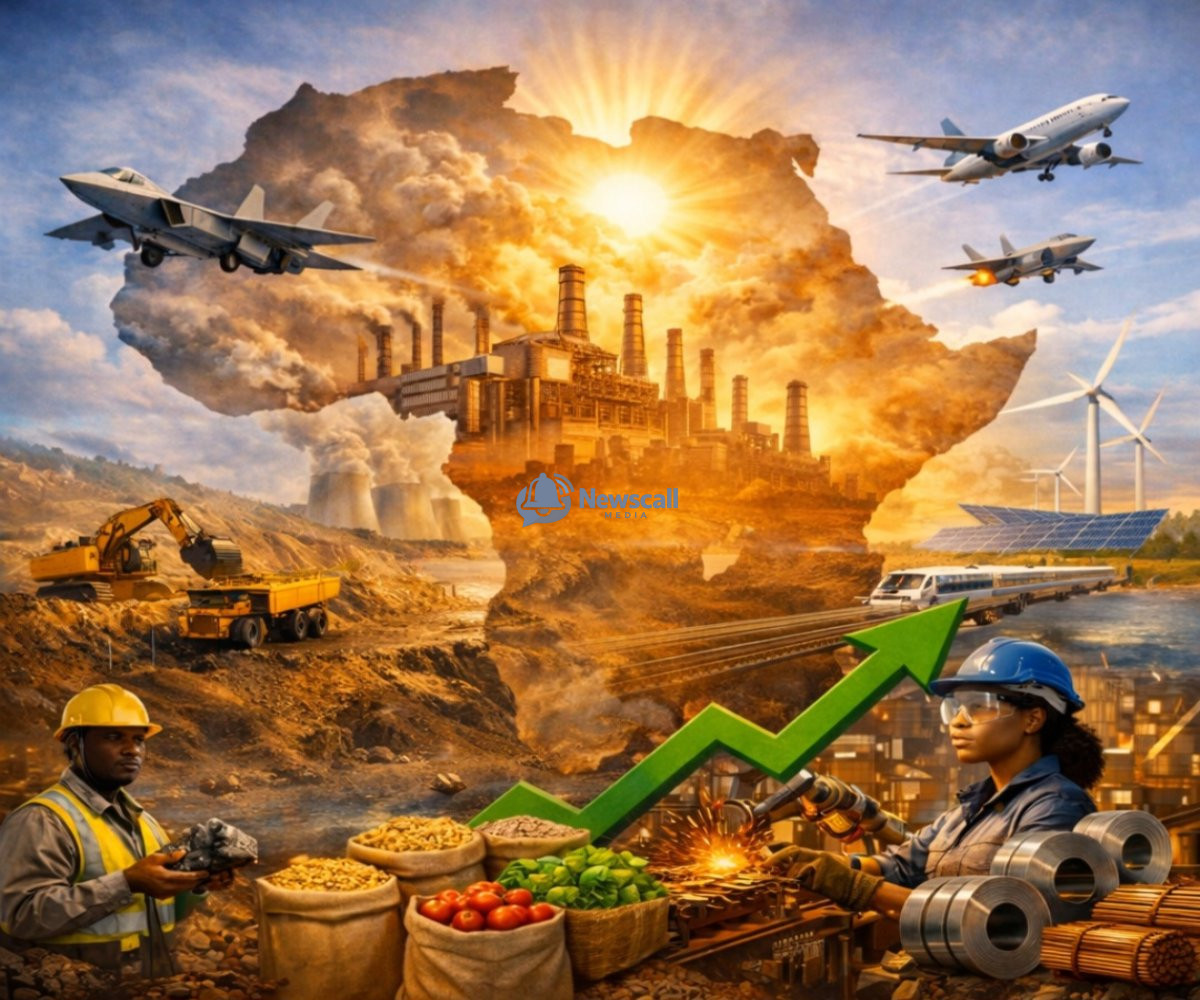
"Africa Rising: From Mines to Manufacturing, a Continent Battles Hunger to Forge Industrial Power”
Growth Amid Global Turbulence
Sub-Saharan Africa’s economy is expected to expand by 4.1–4.5% in 2026, according to the World Bank and IMF. This marks one of the fastest growth rates globally, driven by domestic demand, high commodity prices, and regional integration under the African Continental Free Trade Area (AfCFTA). Yet per-capita growth remains modest at 1.5–2%, insufficient to reduce poverty or absorb the continent’s rapidly expanding labor force—620 million new entrants are expected by 2050.
From Raw Exports to Value Addition
Africa’s industrial push is increasingly focused on value addition to raw materials. Countries such as Ghana, Nigeria, and the Democratic Republic of Congo are investing in refining critical minerals—cobalt, lithium, and rare earths—essential for the global green transition. Manufacturing hubs are emerging in Kenya, Rwanda, and Ethiopia, leveraging digital innovation and renewable energy to attract investment.
The AfCFTA, covering 1.4 billion people and a combined GDP of $3.4 trillion, is central to this transformation. By reducing tariffs and harmonizing standards, it could boost real incomes by 7% (about $450 billion) and expand consumer and business spending to $6.7 trillion by 2030.
The Hunger Challenge
Yet industrial ambitions are shadowed by a worsening food crisis. Rising oil and fertilizer prices—exacerbated by the Middle East conflict—are driving up agricultural costs. The IMF estimates that a 20% increase in global food prices could push 20 million Africans into severe food insecurity in 2026.
Countries reliant on imports, such as Kenya and Senegal, face deteriorating trade balances and higher living costs. Meanwhile, oil exporters like Nigeria and Angola benefit from stronger revenues but remain vulnerable to volatility.
Policy Crossroads
Governments are under pressure to balance industrial policy with social protection. The World Bank urges investment in enabling ecosystems—power, transport, skills, and finance—to crowd in private capital and sustain transformation. At the same time, targeted subsidies and safety nets are needed to shield vulnerable populations from rising food and energy costs.
Risks and Opportunities
Africa’s rise is not without risks. Debt burdens, political instability, and climate impacts threaten progress. Wildfires, droughts, and floods in 2025 destroyed over one million hectares of farmland, underscoring the vulnerability of agriculture. Yet opportunities abound: Africa holds a quarter of the world’s arable land, vast renewable energy potential, and a youthful, urbanizing population driving digital innovation.
Conclusion
Africa’s story in 2026 is one of resilience and ambition. From mines to manufacturing, the continent is striving to break free from its historic dependence on raw exports. But hunger remains a formidable obstacle, reminding policymakers that industrial power must be built alongside food security.
The world is watching. Africa’s success—or failure—in this balancing act will shape not only its own destiny but the future of global trade, energy, and development.

OKORO WILSON EGWU
“Independent journalist delivering sharp, reporting on global conflicts, humanitarian crises, and international diplomacy. Known for transforming complex world events into...